
Comment évaluer la fiabilité des machines de moulage par soufflage entièrement électriques en 2026 ?
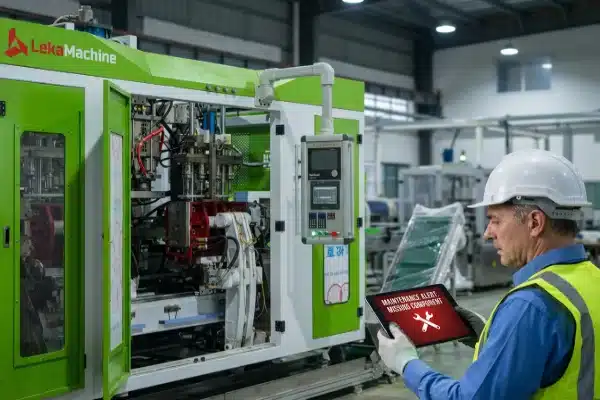
At our factory, we often see clients worried about machine downtime caused by missing parts Bill of Materials (BOM) health 1. You need equipment that runs continuously, not production delays due to fragile global supply chains 2. (29 words)
To evaluate reliability, you must audit the OEM’s Bill of Materials (BOM) health, specifically verifying the availability of long-lead items like planetary roller screws and high-torque servo motors. Do not rely on sales promises; demand a current component lifecycle report to avoid obsolescence risks. (42 words)
Below, we break down the specific checkpoints you need to verify before signing a purchase contract Planetary Roller Screws 3.
Is the Supply Chain for Critical All-Electric Components Stable Enough for 2026?
Our engineering team knows that sourcing specific high-torque motors can be difficult during shortages manufacturer’s derating curves 4. You cannot afford to wait months for a replacement part when your production line stops. (29 words)
Stability depends on the manufacturer’s leverage over Tier 1 suppliers like Siemens and Beckhoff. You must verify if the specific servo drives and roller screws in your machine are standard catalog items or custom "long-lead" components that require 40 weeks to replace. (41 words)
The Shift from Hydraulic to Electric Risks
In the past, fixing a hydraulic machine was straightforward Vendor Managed Inventory (VMI) clause 5. We could buy standard valves or pumps from local distributors. Today, the all-electric era has changed the rules. The critical path to keeping your machine running involves complex electronics and precision mechanics obsolescence protection guarantee 6.
These components are not commodities. They are sophisticated assemblies. If a specific servo motor fails, you cannot simply swap it with a generic brand.
The "Long-Lead" Component Trap
When we build machines, we identify "long-lead" parts. These are components you cannot buy off the shelf in 24 hours.
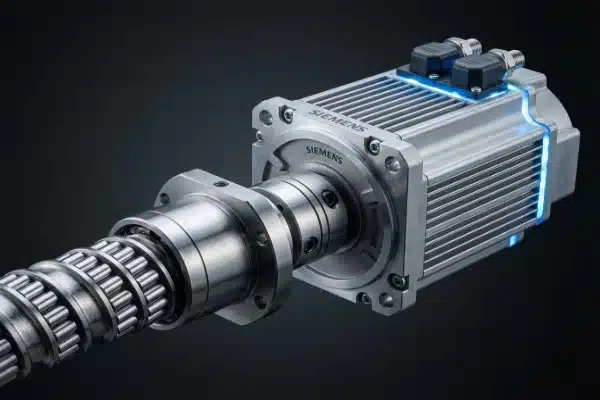
- Servo Motors: High-torque motors used for clamping generate significant heat. Standard motors often fail here. If the machine uses a custom winding, a replacement might take months to build.
- Planetary Roller Screws (PRS): This is the heart of the electric clamp. It takes massive loads. Only a few companies in Europe and the USA make them.
- Drive Controllers: These require specific firmware. A mismatch between the drive and the PLC can force a total system upgrade.
Supplier Ecosystem Analysis
We monitor the status of major component suppliers to ensure our inventory remains healthy. The table below shows the current status of key component providers in the industry.
Table 1: Critical Component Supplier Status (2026 Outlook)
| Component Category | Key Supplier | Current Lead Time Risk | Regional Support (USA) |
|---|---|---|---|
| Servo Drives | Siemens (S120) | Haut (Phase-out/Allocation) | Excellent distributor network. |
| Servo Drives | Beckhoff | Moyen (Chip dependency) | Growing (New hubs in CA/IL). |
| Roller Screws | Moog | Moyen (Custom ends delay) | Strong manufacturing base. |
| Roller Screws | Rollvis | Haut (20-30 weeks) | Low (Import only). |
| Controls (IPC) | B&R (ABB) | Faible (Stable) | Strong partner network. |
The Obsolescence Cliff
A major risk we see in 2026 is the "Product Discontinuation" of older drive systems. For example, certain Siemens "Booksize" modules are phasing out. If you buy a new machine today with these older parts, you are buying "technical debt." You might face obsolescence issues in just 5 years. Always ask if the drives are the latest generation (like the S210 or updated S120).
How Can I Determine if the Heat Dissipation Performance of Servo Drives is Effective?
When we calibrate our flight controllers and servo systems, we know heat is the enemy of precision. Overheating drives leads to sudden shutdowns and expensive production losses for your factory. (30 words)
You must confirm if the electrical cabinet features active air conditioning rather than just ventilation fans. Additionally, review the manufacturer’s derating curves to ensure the drives are sized with enough margin to operate continuously at your factory’s maximum ambient temperature without throttling performance. (42 words)
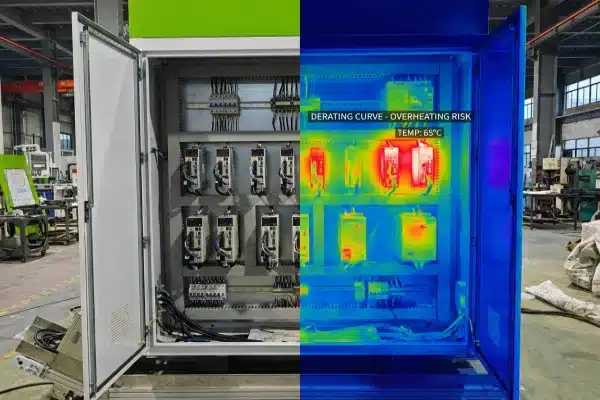
Why Heat Dissipation Matters
In all-electric machines, the servo drives work hard. They accelerate the mold and hold it closed under tons of pressure. This "stall torque" creates massive heat. If this heat is not removed, the drive will protect itself by shutting down or reducing power.
Critical Checks for Cooling Performance
We recommend a rigorous inspection of the cooling systems before you accept a machine.
1. Cabinet Cooling Architecture
Does the electrical cabinet use simple fans or an active air conditioner?
- Fans: These only work if the air outside is cool. If your factory is 35°C (95°F), fans simply blow hot air onto hot drives. This is often insufficient for high-speed cycling.
- Active AC: This acts like a refrigerator for the electronics. It keeps the internal temperature stable, regardless of how hot your factory floor gets.
2. The Derating Curve
Every servo drive has a "derating curve." This chart shows how much power the drive loses as it gets hotter.
- Typically, performance drops by 5% for every 5°C increase above 40°C.
- If the manufacturer sized the drive "just right" for 25°C, it will fail when your plant hits 40°C in the summer.
- We always look for drives sized with extra margin to handle these peaks.
3. Real-Time Monitoring
You should not need a thermometer to check safety. The machine’s HMI (screen) should display the real-time temperature of the main servo drives. If the temperature climbs near the limit (usually 85-90°C), the operator needs an early warning system.
Comparison of Cooling Methods
Different machines use different strategies to keep cool. Here is how they compare in effectiveness.
Table 2: Servo Drive Cooling Method Effectiveness
| Cooling Method | Heat Removal Capacity | Reliability Risk | Meilleure application |
|---|---|---|---|
| Forced Air (Fans) | Low to Medium | High (Dependent on ambient air) | Clean, cool, climate-controlled rooms. |
| Active Cabinet AC | Haut | Low (Closed loop system) | Hot, humid, or dusty factory floors. |
| Liquid Cold Plate | Très élevé | Medium (Leak risk/Maintenance) | Ultra-high performance, compact machines. |
Conducting a Thermal Audit
When you visit the supplier for a FAT (Factory Acceptance Test), bring a thermal camera. Run the machine at full speed for 4 hours. Scan the heat sinks. If you see "hot spots" above 70°C or uneven heat distribution, the cooling installation is poor. Check that the thermal paste is applied correctly and that the drive makes full contact with the mounting plate.
What Contractual Safeguards Should I Demand to Ensure Long-Term Machine Support?
Our experience exporting machinery has taught us that verbal promises do not fix broken machines. You need binding agreements to ensure you get the support and parts you paid for. (30 words)
Negotiate a Vendor Managed Inventory (VMI) clause requiring the supplier to stock critical spares like roller screws domestically. Furthermore, include an obsolescence protection guarantee that obligates the supplier to engineer a retrofit solution if a critical component becomes unavailable within ten years. (41 words)

Moving Beyond Verbal Assurances
Salespeople often say, "We have plenty of spare parts." But what does that mean? Does it mean they have votre specific part, or just general parts? We advise you to ignore verbal guarantees and focus on the contract.
The "Touch Test" Audit
Before you sign, ask to see the spare parts warehouse. Do not just look at the assembly floor.
- Ask to see a Planetary Roller Screw for your specific machine size.
- If they say, "We don’t stock those because they rarely fail," be careful.
- "Rarely fails" means "catastrophic downtime" when it does happen. A stable supplier invests money in slow-moving inventory to protect you.
Essential Contract Clauses
We suggest adding specific language to your purchase agreement to shift the risk back to the supplier.
1. The VMI Clause
Require the supplier to keep critical spares in your country.
- Sample Logic: "Supplier agrees to keep one replacement unit for every unique servo motor and roller screw at their North American facility. Failure to ship within 24 hours results in a penalty."
2. The BOM Health Report
Make the "Bill of Materials Health Report" a requirement for the final payment.
- This report must list every electronic part.
- It must show the "Lifecycle Status" (Active, Phase-out, or Obsolete).
- Refuse to accept a machine delivered with parts listed as "Last Time Buy" (LTB).
3. Right to Repair / Software Escrow
If the supplier uses proprietary "Black Box" controls, you are at risk if they go bankrupt.
- Ask for a clause that releases the software source code to you if the supplier ceases operations. This allows a third party to fix your machine in an emergency.
Assessing Supplier Risk Profiles
Not all suppliers carry the same risk. The table below categorizes common supplier types based on their supply chain stability.
Table 3: Supplier Supply Chain Risk Assessment
| Type de Fournisseur | Inventory Strategy | Risk Level | Mitigation Strategy |
|---|---|---|---|
| Domestic Manufacturer | Stocks parts locally; standardized platforms. | Faible | Verify inventory depth during visit. |
| Global Giant (Acquired) | Hybrid supply chains; integration phase. | Moyen | Clarify origin of parts (e.g., German vs. Chinese screws). |
| Niche European Brand | High-tech but distant; relies on air freight. | Haut | Demand a localized "Crash Kit" of spares on site. |
| Private Equity Owned | "Lean" inventory models to boost profit. | Medium/High | Strict contractual VMI clauses are required. |
The "Allocation" Litmus Test
Finally, ask the supplier: "Is your primary servo drive supplier currently on Allocation?"
If a chip manufacturer puts a supplier on "allocation," it means the supplier only gets a fixed number of chips per month. Even if they want to help you, they physically cannot ship a spare drive because they need it to finish new machines. If they admit they are on allocation, you must buy a full set of spare drives immediately with the machine purchase.
Conclusion
To ensure resilience, you must audit the BOM, verify cooling systems, and sign contracts that guarantee local spare parts availability. (20 words)
notes de bas de page
- Explains what a Bill of Materials (BOM) is and its importance in manufacturing. ↩︎
- Defines global supply chains and their management. ↩︎
- Replaced HTTP 404 with an authoritative Wikipedia page explaining Planetary Roller Screws. Anchor text slightly adjusted for common usage. ↩︎
- Explains what derating curves are and how to interpret them for power supplies. ↩︎
- Provides a standard form for a Vendor Managed Inventory (VMI) agreement. ↩︎
- Discusses planned obsolescence and consumer protection in the context of product longevity. ↩︎


0 commentaires