
Avant de me décider à acheter, quelles vidéos de fonctionnement de la machine de moulage par extrusion-soufflage entièrement électrique dois-je demander au fournisseur ?

At our factory, we understand that purchasing capital equipment 1 from overseas feels like a gamble. We know the anxiety of looking at a glossy brochure and wondering if the actual machine can deliver stable production or if it is just a prototype. Standard marketing clips often hide flaws, but you need to see the raw reality before shipping.
You must request unedited footage that exposes mechanical reality, not just marketing highlights. Specifically, demand a continuous 15-minute production run to check stability, a bottom-up view of the die head to verify parison control, and a "dry cycle" audio recording to detect mechanical wear or lubrication issues.
These requests will filter out confident suppliers from those hiding performance issues. Read on to discover exactly what to ask for.
How can I verify the machine’s actual production stability?
When we calibrate our flight controllers and servo systems 2, we look for consistency over time, not just a lucky shot. In our experience, many machines look great for thirty seconds but drift thermally after ten minutes. You need video evidence that proves the machine holds its settings.
To verify stability, request a continuous, unedited 15-minute video showing steady-state production. This specific duration reveals cycle time variance and thermal drift without the file size of a 24-hour recording. Also, ask for a real-time view of the energy monitor to confirm regenerative braking actually functions.
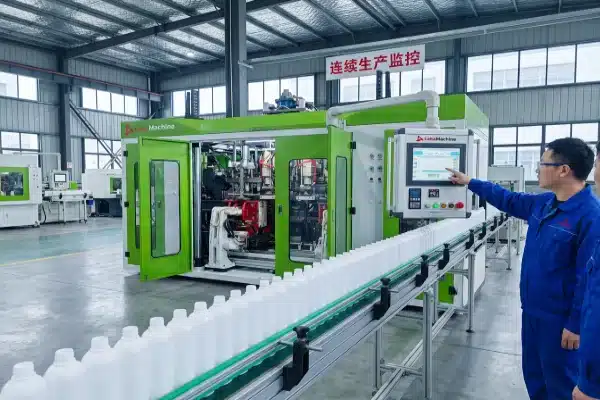
Requesting the right duration and audio setup is crucial for assessing mechanical health 3 without visiting the factory.
The "Continuous 15-Minute" Uncut Clip
Most suppliers will send you a 30-second "highlight reel" set to upbeat music. This is useless for engineering validation. We advise our clients to demand a raw, unedited 15-minute video file. Why 15 minutes? In our testing, thermal drift in the servo motors 4 or heater bands usually becomes visible within this window.
If the cycle time at minute 1 is 12.0 seconds, but by minute 14 it has drifted to 12.8 seconds, the machine has inadequate cooling or poor PID loop tuning 5. You should also watch the "Power Consumption" graph on the HMI screen. On all-electric machines, we expect to see negative spikes in the power graph. This confirms that the "Regenerative Braking" (recovering energy during deceleration) is active. If the graph only shows positive spikes, the machine is less efficient than advertised.
The Acoustic Signature Test
Visuals can be deceiving, but audio rarely lies. We recommend asking for an "Audio-Only Dry Cycle" video. This means the machine runs at full speed without plastic, and crucially, without background music. You want to hear the mechanical movements.
- Whining Sounds: Often indicate ball screw wear or insufficient lubrication.
- Clunking: Suggests play in the toggle linkages or loose platen guides.
- Hissing: Even in all-electric machines, pneumatic valves are used for blowing; hissing indicates air leaks which cost money.
Video Type Comparison Matrix
Use this table to understand the difference between what sales teams send and what you actually need.
| Video Type | What It Shows | What It Hides | Verdict |
|---|---|---|---|
| Marketing Highlight | Fast cycles, shiny paint, upbeat music. | Cycle inconsistencies, strange noises, setup time. | Reject |
| 24-Hour Timelapse | General output volume. | Micro-stoppages, detailed cycle variance, vibration. | Optionnel |
| 15-Min Raw Cut | Thermal drift, cycle variance, actual noise. | Long-term wear patterns. | Mandatory |
| Dry Cycle (No Audio) | Speed of movement. | Mechanical condition of bearings and screws. | Reject |
In our assembly area, we know that the most critical moment in moulage par soufflage 6 is when the parison drops. Standard side-view videos often obscure the most common extrusion defects. To see what is really happening, you have to ask the supplier to move the camera to uncomfortable positions.
Standard side views hide critical defects. You need a camera angle looking directly up at the extrusion die to spot "curtaining" or melt fracture in the parison. Additionally, request slow-motion footage of the deflashing station to ensure the punch shears flash cleanly rather than tearing it due to timing errors.
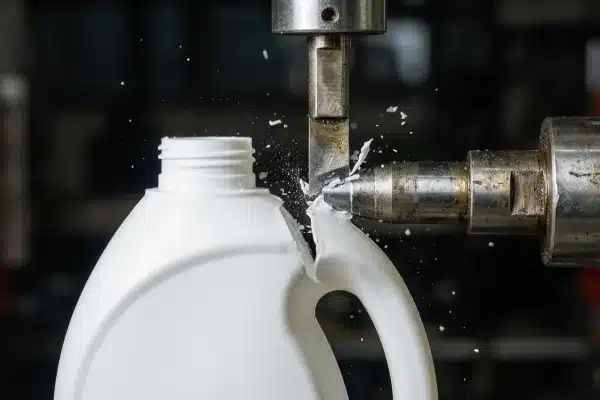
These specific angles expose whether the machine is truly precision-engineered or just roughly assembled.
The Bottom-Up Truth
When we troubleshoot extrusion issues, we always look from the bottom up. A side view makes a parison look straight even if it is not. By demanding a video shot from the mold area looking up at the die head, you can detect three specific killers of bottle quality:
- Curtaining: Where one side of the parison flows faster than the other, causing uneven wall thickness.
- Banana-ing (Curling): The parison curls upward or to the side as it exits. This usually indicates poor heater band calibration or a die head that isn’t centered.
- Melt Fracture: A rough, "shark-skin" texture on the plastic, indicating the extruder is struggling with the material or temperature.
If a supplier refuses this angle, they may be hiding poor die tooling design.
Servo "Standstill" Stability
One of the nuanced tests we perform involves zooming in on the platen while it is clamped. Unlike hydraulic machines that lock physically, an all-electric servo machine must actively hold torque to keep the mold closed.
Request a zoomed-in video of the platen during the "High Pressure" blowing phase. If the PID loop is poorly tuned, you will see "micro-shaking" or "hunting" as the motor fights to hold position. This vibration transfers to the bottle, causing surface defects or parting line issues. A solid machine should look visually frozen while holding tonnage.
Deflashing Dynamics
Deflashing happens in milliseconds. At normal speed, you cannot tell if the punch is sharp or if the machine is just tearing the plastic off. Request high-framerate (slow-motion) footage. You want to verify that the servo transfer arm and the punching station are perfectly synchronized. If the timing is off by even 50 milliseconds, the bottle will be slightly out of position, leading to "tearing" at the neck or handle, which leaves sharp, dangerous burrs on the final product.
Common Defects Visible by Angle
| Defect Type | Side View Visibility | Bottom-Up View Visibility | Root Cause |
|---|---|---|---|
| Parison Curling | Faible | Haut | Uneven die heating or die alignment. |
| Die Lines | Moyen | Haut | Dirty die lip or degraded material. |
| Oval Parison | Faible | Haut | Incorrect die swell calculation. |
| Flash Tearing | Faible | High (Slow Mo) | Misaligned deflashing striker/punch. |
Which videos prove the machine is efficient and safe to operate?
We prioritize safety and ease of use in our designs because we know that a difficult machine ruins profitability. It is easy to claim "tool-less changeover" or "safety systems" in a catalog, but seeing is believing. You need to verify that the machine protects your mold and your operators.
Request a low-pressure mold protection demo where a soft object is placed between closing molds to test safety sensitivity. Furthermore, ask for a video of the actual mold unlocking process to validate "tool-less" claims, and a purge test transitioning from black to white resin to expose dead spots.
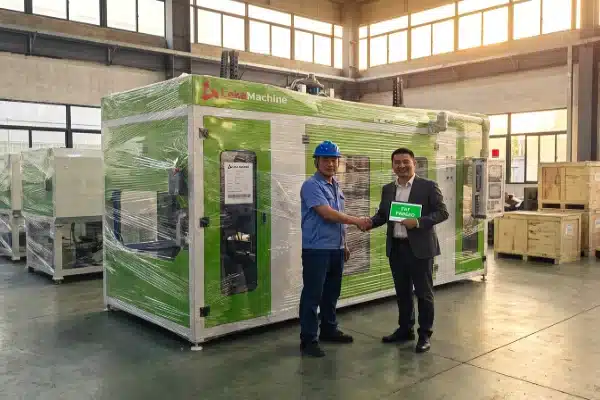
These operational tests prove that the machine is not just a production unit, but a user-friendly system designed for the real world.
The "Paper Cup" Safety Test
One of the most impressive yet essential tests we recommend is the Low-Pressure Mold Protection test. Ask the supplier to tape a paper cup or a small plastic bottle between the mold halves and initiate a cycle.
On a high-quality all-electric machine, the servo motor should detect the slight resistance of the paper cup immediately. The machine should stop and retract before crushing the cup. If the machine crushes the cup flat, it will likely crush your expensive mold if a bottle ever gets stuck during production. This test validates the sensitivity of the motor feedback loops and the safety logic programmed into the controller.
extrusion defects 7
The Color Change Purge Test
Efficiency isn’t just about cycle time; it’s about downtime. We suggest asking for a video showing a transition from a dark resin (black or blue) to a natural/white resin.
Freinage régénératif 8
This video is the ultimate lie detector for the extrusion head design.
- Good Design: The color streaks should disappear quickly and evenly.
- Bad Design: You will see streaks lingering for a long time, or "bursts" of black color appearing randomly after the material looks clear.
These random bursts indicate "dead spots" in the flow channel where degraded material accumulates. This is a nightmare for production quality and implies the extrusion head needs a redesign.
Power Consumption 9
Quick Mold Change (SMED) Verification
Finally, do not accept the claim of "30-minute mold changes" without proof. Ask for a video documenting the unlocking and removal of the mold. Does the technician use a simple impact driver, or are they struggling with heavy wrenches and sledgehammers? Does the machine have a "Mold Change Mode" on the screen that automatically positions the platens? A video showing the actual workspace ergonomics can save your technicians hours of frustration later.
safety systems 10
Operational Verification Checklist
| Test Requested | What You Are Verifying | Passing Criteria |
|---|---|---|
| Mold Protection | Servo sensitivity & safety logic. | Machine stops before crushing a paper cup. |
| Color Purge | Rheology design of the die head. | Complete color transition with no lingering streaks. |
| Power-Off Recovery | Absolute Encoders & Logic. | Machine restarts without needing a full "homing" sequence. |
| Mold Removal | SMED features & ergonomics. | One operator can unlock the mold without heavy sledges. |
Conclusion
To protect your capital, move beyond the brochure. By demanding these specific videos—especially the 15-minute continuous run, les bottom-up parison view, and the mold protection test—you force the supplier to prove their engineering quality. Transparency is the ultimate specification.
notes de bas de page
- Recent news context on global capital equipment spending and investment trends. ↩︎
- Technical standards and research on high-performance servo systems in manufacturing. ↩︎
- ISO standard for vibration monitoring and mechanical health of machines. ↩︎
- Technical documentation for high-performance industrial servo motors used in precision machinery. ↩︎
- Explains the control logic used for thermal and motor stability. ↩︎
- Provides a general overview of the blow molding process for context. ↩︎
- Academic research on identifying and mitigating common polymer extrusion defects. ↩︎
- Technical explanation of regenerative braking in industrial servo drives from a major manufacturer. ↩︎
- DOE resources on industrial motor efficiency and power consumption monitoring. ↩︎
- Official OSHA guidelines on machine guarding and safety systems for industrial equipment. ↩︎


0 commentaires