
Purchasing an All-Electric Co-Extrusion Machine: How Do I Ensure Precision Layer Thickness Control?
At our facility, we often encounter clients who struggle with the high costs of EVOH barrier materials 1. We know that choosing a machine with poor thickness control effectively burns money every hour the machine runs. If you cannot control the barrier layer, you face delamination issues and wasted resin die head geometry 2. This guide helps you ask the right questions to secure a machine that guarantees precision.
To ensure precise layer thickness control, ask suppliers about their die head geometry (spiral mandrel vs. spider-leg) and independent servo regulation for each extruder. Request data on real-time torque monitoring and closed-loop feedback systems that automatically adjust screw speeds to maintain consistent layer ratios despite material viscosity changes.
Here are the specific technical inquiries you must make to validate a supplier’s technology Spiral Mandrel Distribution System 3.
How does the control system ensure uniform thickness for the EVOH barrier layer?
When we calibrate machines for our European clients, we prioritize the concentricity of the barrier layer above almost everything else Radial Wall Thickness Control (PWDS) 4. If the EVOH layer is too thin in one spot, the bottle fails shelf-life tests; if it is too thick, your material costs skyrocket.
A robust control system ensures uniform EVOH thickness by using a spiral mandrel die head design to eliminate weld lines. It must integrate with Gravimetric control to adjust extruder output based on bulk density, ensuring the barrier layer remains continuous and concentric even during complex parison programming.
The Importance of Die Head Geometry
The physical design of the die head is the foundation of thickness control Gravimetric Blenders 5. In our engineering meetings, we emphasize that software cannot fix a bad mechanical design. You must verify if the machine uses a Spiral Mandrel Distribution System.
Many budget machines use “spider-leg” designs. These support legs split the plastic flow and try to knit it back together Melt Gear Pump 6. For standard HDPE, this is acceptable. For a thin EVOH barrier layer, however, these split points create “weld lines.” These are weak points where the barrier often breaks or thins out significantly. A spiral mandrel eliminates these legs, ensuring a continuous, overlapping flow that creates a perfect 360-degree ring of EVOH.
Critical Components for Uniformity
To guarantee uniformity, the machine must combine mechanical design with smart feedback.
Table: Impact of Die Design on Layer Integrity
| Fonctionnalité | Spiral Mandrel System | Spider-Leg Design | Impact on Production |
|---|---|---|---|
| Flow Continuity | Continuous, overlapping flow | Flow is split and re-knitted | Spiral prevents barrier holes. |
| Weld Lines | Aucun | Prominent | Weld lines cause bottle leaks. |
| Pressure Balance | High internal pressure balance | Uneven pressure zones | Balanced pressure equals even thickness. |
| Utilisation des matériaux | Optimized (can run thinner layers) | Wasteful (needs thicker layers to be safe) | Spiral saves 10-15% on EVOH costs. |
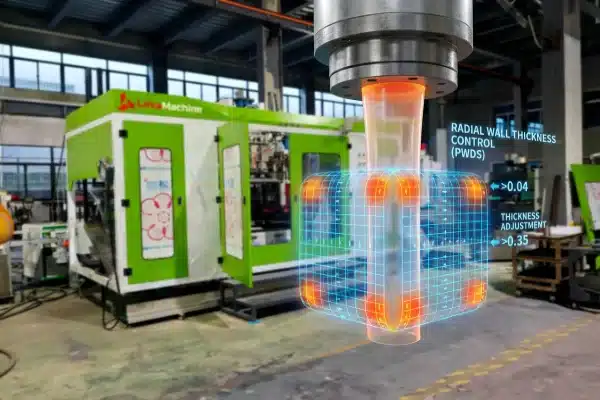
Radial Wall Thickness Control (PWDS)
Axial programming (controlling thickness from top to bottom) is standard. However, for complex bottle shapes—like a jerry can with a handle—you need Radial Wall Thickness Control (PWDS). This technology actively shifts the die gap off-center dynamically as the parison extrudes. This ensures the barrier layer does not stretch too thin at the corners of a square bottle. Without PWDS, you must thicken the entire bottle just to make the corners safe, which is a massive waste of material.
Can I adjust the flow ratio of each layer independently while the machine is running?
Our service engineers have found that operators often hesitate to optimize settings if it requires stopping the machine. Shutting down to adjust a tie-layer disrupts the thermal stability of the entire head. You need a system that allows confident, live adjustments.
Yes, high-end all-electric machines allow on-the-fly adjustment of individual layer flow ratios. This is achieved through independent servo motors with closed-loop feedback for each extruder, enabling you to fine-tune the adhesive or barrier layer percentage without stopping the machine or disrupting the stability of other layers.
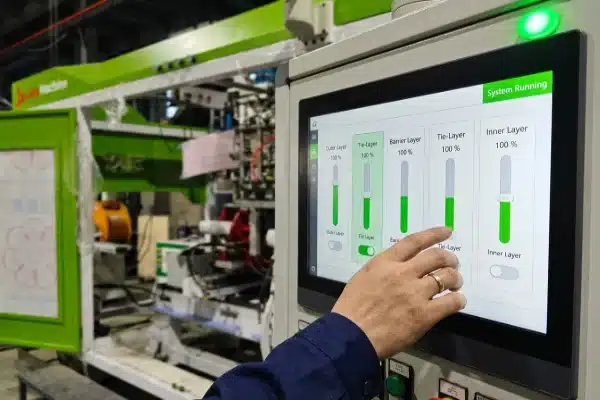
The Power of Independent Servo Regulation
In a multi-layer system (e.g., 6 layers), you might have five or six separate extruders feeding one head. In older hydraulic or AC-motor systems, changing the speed of one extruder often caused pressure fluctuations that affected the others.
With an All-Electric system, each extruder is driven by its own dedicated Servo Motor. These motors are “stiff,” meaning they do not slow down under load changes. This allows you to increase the flow of the adhesive tie-layer by 2% without changing the flow of the outer HDPE layer.
Gravimetric Integration
Layer thickness stability starts before the plastic even melts. We strongly recommend integrating Gravimetric Blenders that communicate directly with the extruder controller.
- How it works: The blender weighs the material as it enters. If the bulk density changes (e.g., a new batch of regrind is lighter), the controller automatically speeds up that specific screw.
- The Result: The actual weight of plastic entering the die remains constant, keeping your layer percentages locked in.
Melt Gear Pumps for Ultra-Precision
For applications requiring extreme precision (medical bottles or high-end cosmetics), simply relying on the extruder screw might not be enough. Extruder screws can “surge” slightly.
For the barrier layer, ask if the machine supports a Melt Gear Pump. This device sits between the extruder and the die head. It acts like a metering valve, guaranteeing that exactly X cc of material enters the head per second, regardless of what the extruder is doing. This effectively decouples the pressure generation from the flow control.
Table: Flow Control Technologies Compared
| Technologie | Precision Level | Coût | Meilleure application |
|---|---|---|---|
| Standard VFD AC Motor | Low (Speed fluctuates with load) | Faible | Basic single-layer bottles. |
| Closed-Loop Servo Motor | High (Speed is locked) | Moyenne-élevée | Standard Co-Extrusion (Food/Chem). |
| Melt Gear Pump | Ultra-High (Volumetric metering) | Haut | Medical/Pharma Multi-layer. |
What technology do you use to prevent layer instability or delamination during parison extrusion?
We build our machines understanding that different plastics hate sticking to each other. If the temperature or flow isn’t managed perfectly, the layers will separate (delaminate) or create “zig-zag” waves. This is a common failure point in poorly designed co-extrusion heads.
To prevent delamination and instability, manufacturers must use internal thermal isolation within the die head to separate high-temperature structural layers from heat-sensitive EVOH. Additionally, advanced algorithms monitor shear stress to manage interfacial instability, while high-speed electric parison push-out prevents barrier rupture during the ejection phase.
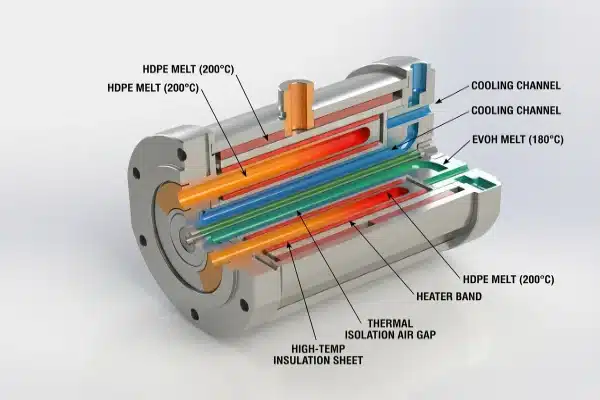
Managing Interfacial Instability
“Interfacial Instability 7” occurs when two molten layers move at different speeds or viscosities, creating a wavy, zig-zag pattern at the contact point. This destroys the clarity and strength of the bottle.
Our logic systems use Shear Stress Monitoring. The software analyzes the flow rates and temperatures. If the viscosity difference between the HDPE and EVOH becomes too great, it can trigger alarms or suggest temperature adjustments. By keeping the viscosities similar at the merger point, the layers flow together smoothly rather than fighting each other.
Thermal Isolation Strategy
A major challenge in co-extrusion is that HDPE processes at a high temperature (around 190-210°C), while EVOH is very sensitive and can degrade if it gets too hot. However, the tie-layer (adhesive) needs specific activation temperatures.
A high-quality die head features Internal Thermal Isolation.
- Air Gaps: Small air gaps or insulation sheets are machined into the steel of the die head.
- Function: These gaps prevent the heat from the massive HDPE flow channels from soaking into the delicate EVOH channels.
- Benefit: This prevents the EVOH from burning (carbonizing) inside the head, which creates black specks and delamination in the final bottle.
The Role of Electric Response
One often overlooked factor is the physical movement of the parison. When the machine pushes the plastic out, it must be smooth. Hydraulic systems can “jerk” or hesitate when the valve opens. This sudden shock can tear the thin EVOH layer inside the melt.
All-Electric Parison Push-out provides superior repeatability. You should ask for response time metrics. A servo-driven system can accelerate from 0 to 100% speed in milliseconds with a perfectly smooth curve. This gentle but fast acceleration protects the internal structure of the multi-layer parison.
Torque-Based Viscosity Compensation
Advanced all-electric systems utilize the high-resolution torque feedback from the servo motors. The system can “feel” the resistance of the plastic.
- If a new batch of EVOH is slightly more viscous, the torque rises.
- The system detects this instantly.
- It automatically adjusts the screw RPM to maintain the correct pressure ratio, ensuring the layer doesn’t get squeezed out by the stronger HDPE layers.
Does the HMI provide real-time visualization of the layer distribution for easier quality control?
Our design team believes that a “black box” machine is a liability. If you cannot see what is happening inside the extruder, you are guessing. Effective quality control requires data visualization that any operator can understand at a glance.
A modern HMI must go beyond basic status lights by providing real-time trending graphs for melt pressure and screw torque for every individual extruder. This visualization allows operators to instantly pinpoint which specific layer is experiencing feed instability or viscosity shifts, enabling immediate correction before defects occur.
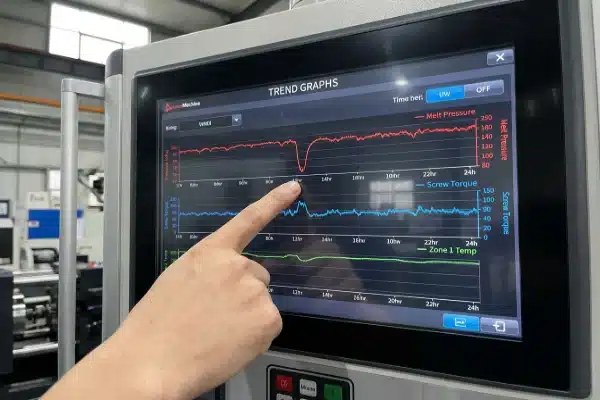
Moving Beyond Simple Numbers
Many basic machines only show a static number: “Extruder A: 40 RPM.” This is useless for troubleshooting. You need Trend Graphs.
Imagine you see a defect in the bottle—a thin stripe in the barrier layer. On a basic machine, you have to guess which of the 5 extruders is surging. On a proper HMI, you look at the “Melt Pressure Trend” graph. You might see that Extruder #3 (the tie-layer) had a pressure drop 20 seconds ago. Now you know exactly where to look—perhaps a bridge in the hopper or a clogged filter.
Key Data Points for Visualization
Your inquiry should demand that the HMI displays the following specific metrics for each layer independently:
- Screw Torque Load (%): Indicates how hard the motor is working. Fluctuations here indicate feed issues.
- Melt Pressure (Bar/Psi): The most critical indicator of flow stability.
- Melt Temperature: Real-time readings at the die entrance.
- Layer Ratio Setpoint vs. Actual: If you set the barrier to 5%, the system should calculate the theoretical output based on screw speed and density to confirm you are close to that target.
Table: HMI Visualization Requirements
| Fonctionnalité | Basic Interface | Advanced Co-Ex Interface | Bénéfice |
|---|---|---|---|
| Data Display | Static Numbers | Rolling Trend Lines (1-24 hours) | Spot intermittent issues easily. |
| Alarm Logic | General “Fault” Light | Specific “Layer 3 Pressure Low” | Faster troubleshooting. |
| Recipe Management | Saves Speeds Only | Saves Speeds, Temps, & Ratios | Perfect repeatability for re-orders. |
| Access Control | Open Access | Tiered (Operator vs. Engineer) | Prevents accidental setting changes. |
Automated Quality Assurance
Ask if the supplier offers “Window Monitoring.” This allows you to set a safety window around your process parameters.
- Example: If the EVOH extruder torque drops below 20% for more than 2 seconds (indicating an empty hopper), the machine automatically triggers an alarm or switches to a “flush” mode to prevent defective bottles from moving downstream. This saves you from shipping bad products to your customer.
Conclusion
To secure a profitable extrusion blow molding line, you must look beyond the price tag and examine the engineering. Prioritize Spiral Mandrel die heads for barrier integrity, insist on Servo-driven independent control for layer flexibility, and demand Deep Visualization on the HMI. These features ensure your investment produces high-quality containers with minimal waste, protecting your margins in the long run.
notes de bas de page
- Explains what EVOH is and its use as a barrier material in packaging, directly relevant to the article’s topic. ↩︎
- Discusses the design rules and importance of spiral mandrel dies, a key aspect of die head geometry. ↩︎
- Details the advantages of spiral mandrel dies, including the avoidance of weld lines for product quality. ↩︎
- Describes the PWDS system for dynamic radial wall thickness control in blow molding, directly matching the anchor. ↩︎
- Authoritative source providing a general overview of gravimetric blenders. ↩︎
- Provides a comprehensive explanation of what a polymer melt gear pump is and its function in plastics processing. ↩︎
- Discusses interfacial instabilities in multilayer extrusion, their causes, and methods for reduction. ↩︎


0 commentaires