

Al comprar una máquina de moldeo por extrusión-soplado totalmente eléctrica, ¿cómo puedo mitigar los riesgos asociados con las fluctuaciones del tipo de cambio?

At our factory, we have seen currency spikes wipe out a client’s projected savings overnight. Volatile exchange rates can turn a profitable machinery investment into a financial headache if you are not prepared, but the right preparation secures your margins.
To mitigate exchange rate risks, utilize Forward Exchange Contracts (FEC) to lock in rates immediately upon signing. Negotiate a "deadband" clause where minor fluctuations (±3%) are absorbed, while major shifts trigger a price adjustment. Additionally, consider paying in the manufacturer’s local currency (CNY) to remove hidden safety buffers often baked into USD quotes.
Let’s look at the specific contractual tools and strategies that protect your capital during the manufacturing process.
Should I lock in the exchange rate within the contract at the time of signing?
When we finalize contracts for our blow molding lines, we often see buyers hesitate on rate clauses because they hope the market will improve. Waiting usually leads to regrettable losses rather than gains.
Yes, locking in the rate is crucial. Specifically, define the "spot rate" based on the official Central Bank closing rate on the Bill of Lading date. Alternatively, implement a "windfall" clause: if the rate shifts in the supplier’s favor, the surplus converts into spare parts credits rather than lost profit.

Locking in the exchange rate is not just about freezing a number; it is about creating a predictable financial environment for your project. When we build custom extrusion blow molding machines, the lead time can range from 4 to 6 months. A lot can happen in the global currency markets during that window.
global currency markets 1
Forward Exchange Contracts (FEC)
The most direct tool at your disposal is the Forward Exchange Contract. Immediately upon signing the machine purchase order, you should book a Forward Contract with your bank. This allows you to lock in the exact exchange rate for your future 70% balance payment.
By doing this, you create fixed cost certainty. It does not matter if the dollar crashes or strengthens during our manufacturing phase; your cost remains exactly what you budgeted. This transforms a variable cost into a fixed cost, which is essential for calculating your ROI accurately.
The Danger of Vague "Current Rate" Terms
We often review contracts from other suppliers that use vague language like "payment at current market rates." This is a trap. You must explicitly define which rate applies.
We recommend using the Bill of Lading "Spot Rate" Lock. This clause explicitly defines that any exchange rate adjustments for the final payment will be calculated based on the official Central Bank closing rate on the specific date of the Bill of Lading issuance. This provides an indisputable reference point that neither party can argue against.
Turning Risk into Reward
Sometimes, the market moves in a way that benefits the supplier. If you agree to a fixed rate and your currency strengthens significantly against ours, the supplier effectively gets "extra" money. You can mitigate this with a "Windfall" Spare Parts Credit.
Insert a clause stating that if the exchange rate shifts significantly in the supplier’s favor (meaning we receive more local currency than expected), that surplus value is not just lost profit for you. Instead, it is returned to you in the form of free spare parts credits—such as extra heating bands, screws, or drive modules.
Table 1: Comparison of Exchange Rate Locking Mechanisms
| Mechanism | Risk Level | Beneficio | Drawback |
|---|---|---|---|
| Floating Rate | Alta | Potential savings if market moves in your favor. | Budget uncertainty; potential for massive cost overrun. |
| Bank FEC | Bajo | 100% budget certainty from Day 1. | Requires a credit line or deposit with your bank; fees apply. |
| Spot Rate Lock | Medio | clear definition prevents disputes. | You still carry the market risk until the ship sails. |
Is it safer to negotiate pricing in my local currency or US dollars?
Our engineering team sources components globally, so we understand currency exposure intimately. Choosing the wrong currency base adds unnecessary risk premiums to your machine quote that you shouldn’t have to pay.
Negotiating in Chinese Yuan (CNY) is often safer because it removes the 5–10% "safety buffer" suppliers add to USD quotes. However, for all-electric machines using European components, splitting the payment—paying for parts in Euros and labor in CNY—can align costs with the supplier’s actual expenses, reducing conversion fees.

Many buyers assume that US Dollars (USD) are the safest bet because it is the global reserve currency. While generally true, there are nuances in the manufacturing sector that can save you significant money if you understand how we price our machines.
global reserve currency 2
Removing the "Safety Buffer" via CNY
When a Chinese manufacturer quotes you in USD, they are taking a risk. To protect themselves against a potential drop in the dollar’s value during production, they often bake a 5-10% hidden margin into the quote. This is their safety buffer.
If you request a quote directly in Chinese Yuan (CNY) and pay using offshore Renminbi (CNH), you effectively remove the need for this buffer. We no longer have to hedge against the dollar, so we can offer a lower net price. This transparency usually results in immediate savings for the buyer.
Component-Based Currency Split
All-electric extrusion blow molding machines are unique because a massive portion of their cost comes from imported European components. Specifically, about 40% of the cost lies in parts like Siemens PLCs, B&R controllers, or Gefran drives.
If you pay us 100% in USD, we have to convert that USD into Euros to pay our component suppliers, losing money on conversion fees each time. A smarter approach is a Component-Based Currency Split. You can propose paying the specific portion for European components in Euros (EUR) and the structural/labor portion in USD or CNY. This aligns your payment with our actual cost structure and avoids double-conversion fees.
When to Stick with USD
Unless your local currency is a major global currency like the Euro or British Pound, you should always negotiate and hold funds in USD. Machinery supply chains—from raw steel to microchips—are priced in dollars. If you try to pay in a volatile local currency (like the Brazilian Real or Turkish Lira), the supplier will be forced to charge a massive risk premium to cover the volatility.
Table 2: Currency Strategy Decision Matrix
| Your Situation | Recommended Currency Strategy | Why? |
|---|---|---|
| US-Based Buyer | USD or CNY | CNY removes the supplier’s hidden risk buffer. |
| European Buyer | EUR / CNY Split | Pay for European parts in EUR to avoid double conversion. |
| Emerging Market Buyer | USD | Holding volatile local currency forces suppliers to overcharge. |
How can staggering my payment terms help manage currency risk during the production period?
During the 4-6 month lead time for custom machines, markets change, and we advise clients to structure payments strategically. Using a rigid, lump-sum payment structure exposes you to unnecessary market timing risks.
Staggering payments into smaller tranches (e.g., 30% deposit, 30% machining, 40% pre-shipment) allows you to dollar-cost average the exchange rate, smoothing out volatility spikes. Conversely, if cash flow permits, paying 90–100% upfront creates an immediate "natural hedge" and often secures a 3–5% discount, eliminating future risk entirely.
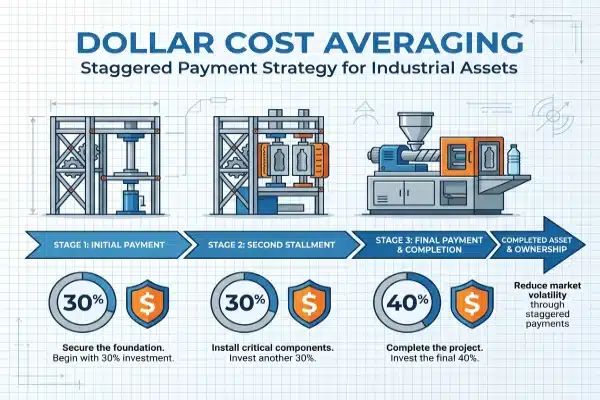
The timing of your money transfers is just as important as the currency itself. By breaking down the payment structure, you can use time to your advantage.
Cost Averaging via Tranches
Instead of a single massive final payment right before shipment, we recommend structuring payment terms into smaller tranches. A typical structure might look like this:
- 30% Deposit
- 30% After Machining / Frame completion
- 40% Before Shipment (after FAT)
This approach acts like "Dollar Cost Averaging" in investing. You are buying the foreign currency at three different points in time. If there is a sudden, temporary spike in the exchange rate, it only affects a portion of your total cost, not the entire balance. This smooths out volatility spikes over the production period.
Dollar Cost Averaging 3
The Power of Full Upfront Payment
If your company has strong liquidity, cash is your best hedging tool. We often offer a heavy discount—typically 3-5%—for clients willing to pay 90-100% of the machine cost upfront.
Why do we do this? Because it gives us immediate working capital and eliminates our risk of non-payment. For you, this effectively eliminates all future currency risk. You pay today’s rate, and the deal is done. Often, the 5% discount exceeds the interest you would earn keeping that cash in a bank, making it a high-ROI move.
Euros (EUR) 4
Natural Hedging via Receivables
If you are an export-oriented business, you might already have a built-in solution. If you sell your finished plastic bottles to the US or Europe, you are receiving USD or Euros.
Do not convert those receivables back into your local currency. Instead, set them aside in a multi-currency account to pay for the machine directly. This is called "Natural Hedging." By using the income from your exports to fund your imports, you bypass conversion fees and exchange rate risks entirely. You are simply moving the same currency through your ecosystem.
What contract clauses can protect me if the currency devalues significantly before delivery?
We believe a contract should be a shield for both parties, not a weapon. Without specific protective clauses, a sudden currency crash can force a supplier to cut corners on quality or force a buyer to default.
offshore Renminbi (CNH) 5
Negotiate a "neutral zone" clause (typically +/- 3%) in the contract; if the exchange rate stays within this band, the price is fixed. However, if it swings beyond 3%, the difference is either split 50/50 or the price is adjusted, preventing catastrophic loss for either party.

The goal of these clauses is fairness. Neither the manufacturer nor the buyer should go bankrupt because of a geopolitical event that crashes a currency.
B&R controllers 7
The "Deadband" Fluctuation Clause
This is one of the most effective tools for long-term projects. You negotiate a "deadband" or neutral zone, typically +/- 3%.
- Scenario A: The currency fluctuates by 2%. Result: No change in price. The supplier absorbs the loss or keeps the gain.
- Scenario B: The currency fluctuates by 10%. Result: The first 3% is absorbed. The remaining 7% is shared.
Typically, we agree to split the difference 50/50 for anything beyond the deadband. This ensures that both parties have "skin in the game" and prevents one side from bearing the catastrophic weight of a currency collapse.
Siemens PLCs 8
Critical Thinking: Why Rigid Contracts Fail
Some buyers insist on a "fixed price no matter what" clause. While this sounds safe, it can backfire. If a currency swings so wildly that the manufacturer is losing money on every machine they build, they may delay your order, prioritize other profitable clients, or subconsciously cut corners on non-critical finishes.
A flexible clause like the Deadband ensures that your partner remains motivated to deliver high quality, even in a turbulent market. It builds a partnership rather than a transactional standoff.
Bill of Lading 9
Table 3: Impact of the Deadband Clause (Example on $100,000 Payment)
| Market Movement | Fluctuation % | Standard Contract Result | Deadband Contract Result |
|---|---|---|---|
| Small Dip | -2% | Supplier loses $2,000 | Price remains fixed (Supplier absorbs) |
| Major Crash | -10% | Supplier loses $10,000 | Excess loss (-7%) is split. Buyer pays partial adjustment to share burden. |
| Major Gain | +10% | Supplier gains $10,000 | Excess gain (+7%) is split. Buyer gets a rebate/credit. |
Conclusión
Currency risk is manageable if you treat it as a strategic element of your purchase. By using FECs, negotiating in CNY, and staggering payments, you protect your ROI and ensure your machine generates profit, not financial stress.
Forward Exchange Contract 10
Notas al pie
- International Monetary Fund factsheet on exchange rate stability and regimes. ↩︎
- Academic analysis from Harvard Kennedy School on the dollar’s global status. ↩︎
- SEC definition of the investment strategy applied here to currency payments. ↩︎
- Official European Central Bank page regarding the currency used for components. ↩︎
- Explains the distinction between onshore and offshore Chinese currency markets. ↩︎
- Official source for the specific drive technology components cited. ↩︎
- Manufacturer documentation for the specific automation hardware referenced. ↩︎
- Official product page for the specific control components mentioned. ↩︎
- Standard definition of the critical shipping document used for date verification. ↩︎
- Official US government guidance on managing foreign exchange risk for exporters. ↩︎


0 Comentarios