
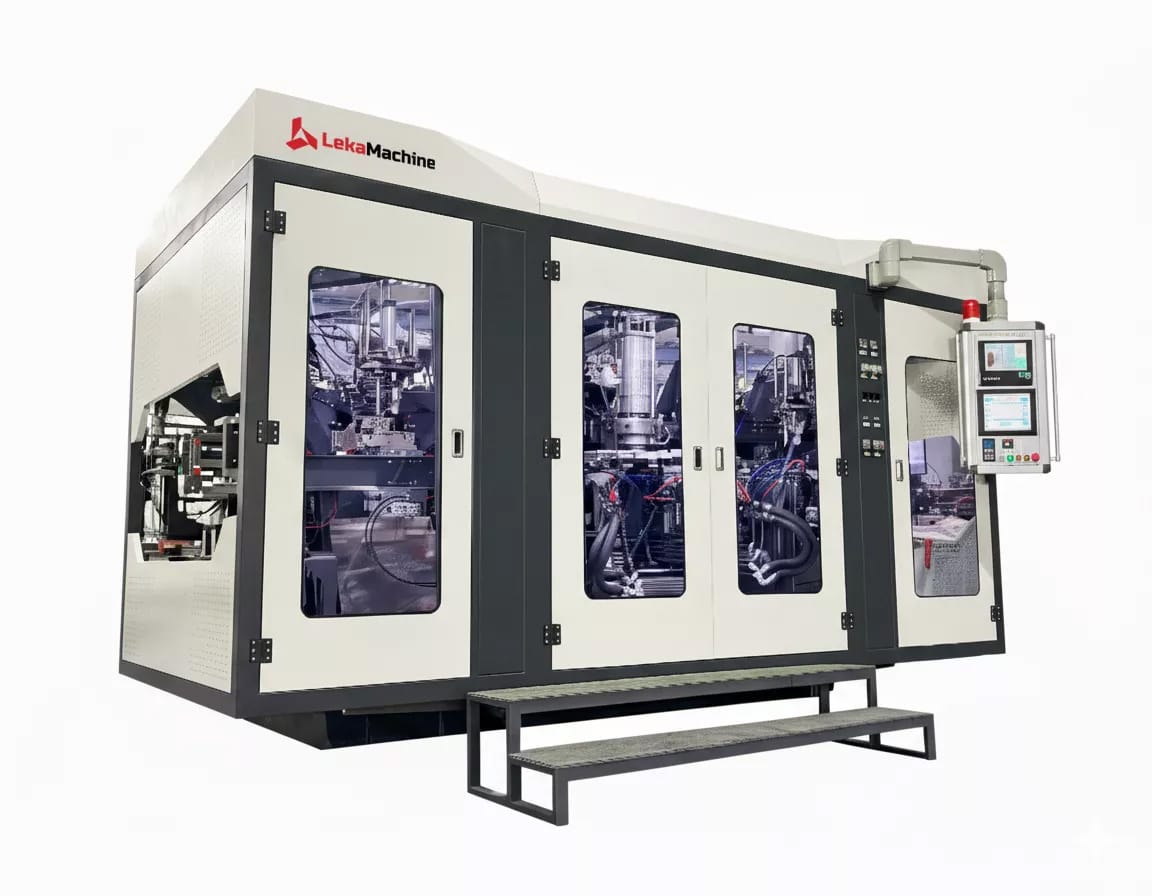
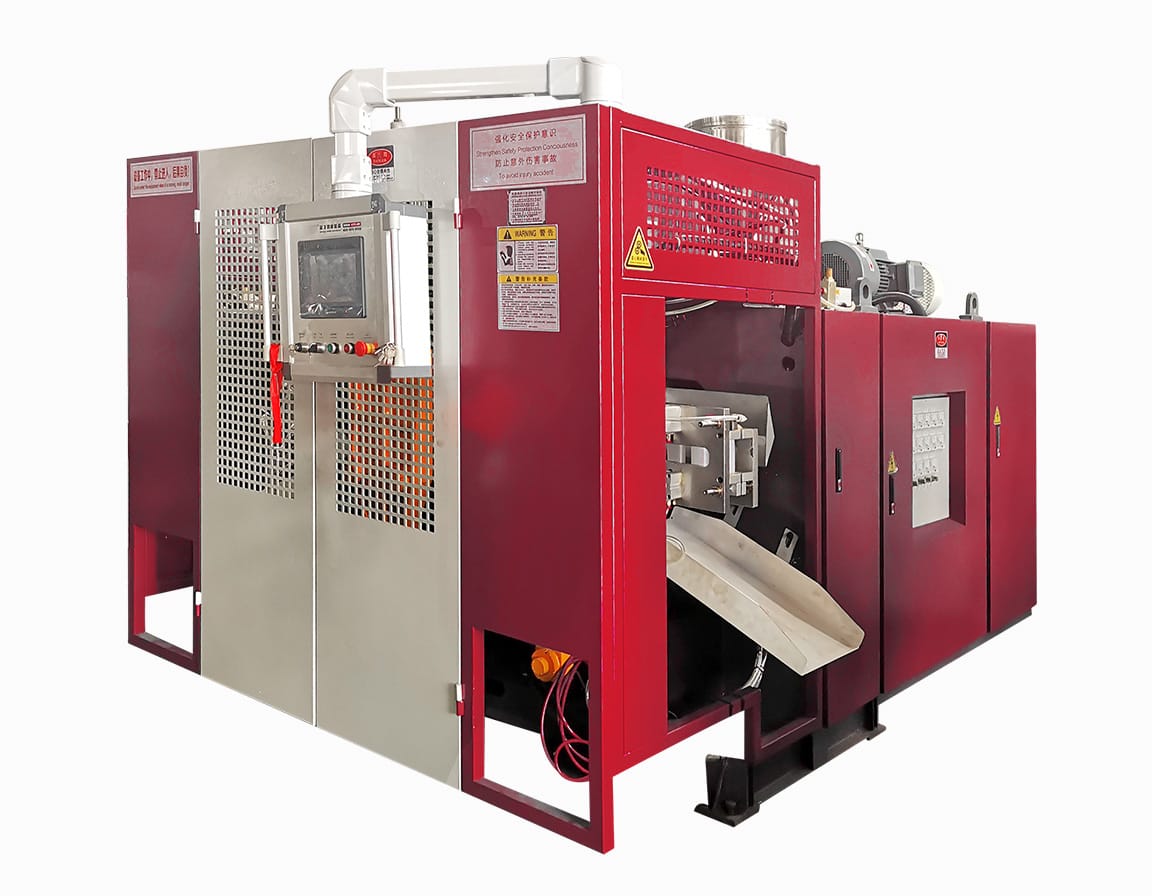

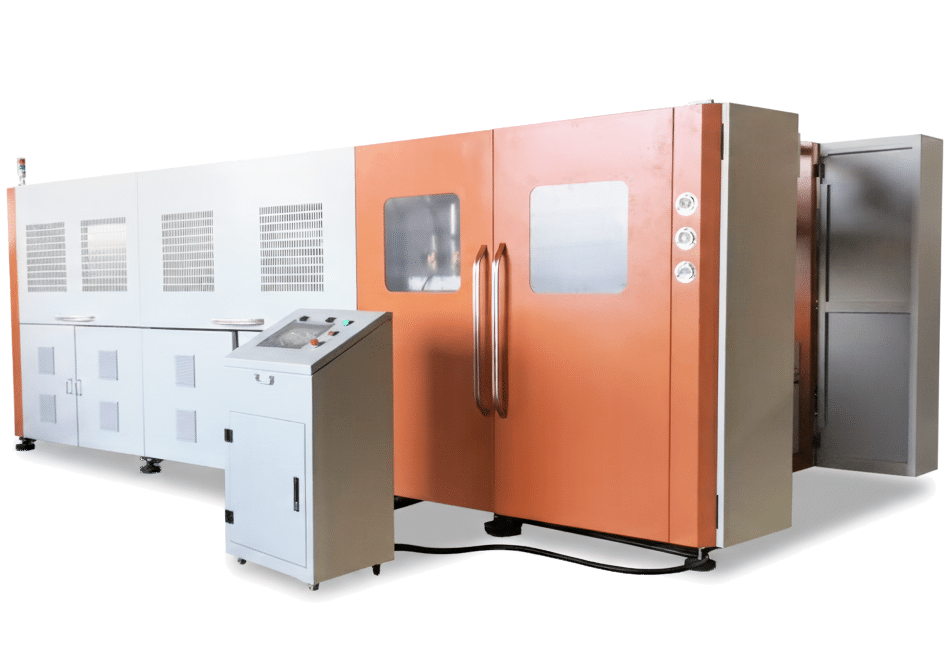

¿Cómo debo verificar que la estructura del bastidor de la máquina de moldeo por soplado y extrusión totalmente eléctrica sea lo suficientemente robusta y duradera?
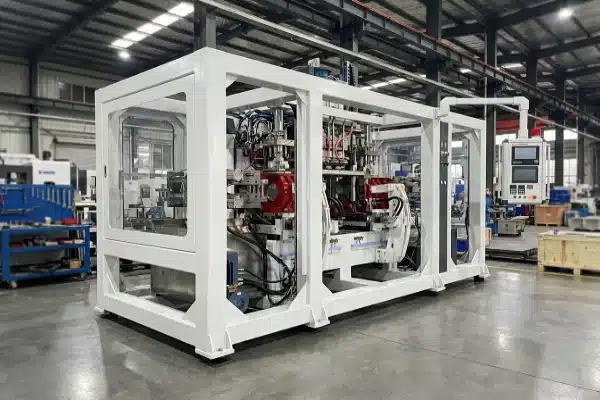
In our assembly hall, we know that a weak frame kills precision faster than any software glitch. When high-speed electric servos brake hard, a flimsy chassis vibrates, causing immediate bottle defects and long-term misalignment.
To verify frame robustness, perform Dye Penetrant Testing on critical welds to find cracks and use an Ultrasonic Thickness Gauge to confirm steel beams exceed 12mm. Additionally, conduct a dry-cycle vibration analysis with a triaxial accelerometer to ensure the mass sufficiently dampens servo motor torque.
To ensure you aren’t buying a machine that will warp after a year of production, follow this structural verification framework.
How do I inspect the welding seams and steel thickness of the machine base?
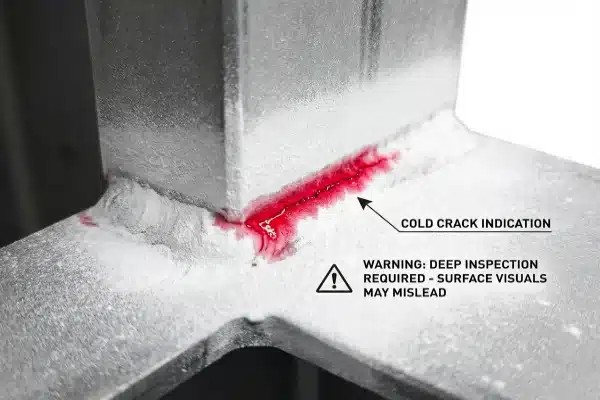
At our factory, we refuse to rely on visual checks alone for quality control. Invisible "cold cracks" in the base or incomplete fusion can propagate catastrophic failure after months of high-speed cycling, destroying machine alignment.
Inspect welding seams using Dye Penetrant Testing (PT) on clamping unit corners to reveal microscopic fissures or incomplete fusion. Simultaneously, verify material specifications by using an ultrasonic thickness gauge on H-beams to ensure they match the promised 12mm+ standard rather than just measuring external dimensions.
disassemble the entire guarding 1
When evaluating the structural backbone of an all-electric blow molding machine, superficial visual inspections are insufficient. You must dig deeper into the metallurgy and fabrication quality.
metallurgy and fabrication quality 2
Dye Penetrant Testing (PT) for Weld Integrity
Visual inspections often miss "cold cracks"—microscopic fractures that occur as the weld cools. In our manufacturing process, we treat the corners of the clamping unit base as critical stress points. You should demand or perform Dye Penetrant Testing (PT).
- Clean the surface thoroughly.
- Apply a red penetrant dye and let it sit for 10–15 minutes to seep into any cracks.
- Wipe off the excess and apply a white developer.
- Observe: If red lines "bleed" out into the white developer, you have a crack or incomplete fusion.
If a manufacturer cannot provide PT reports for the main load-bearing joints, that is a major red flag. These microscopic flaws will expand under the repetitive stress of the mold opening and closing, leading to frame failure.
Safety Factor 3
Ultrasonic Thickness Measurement
A common trick in the machinery market is using standard external dimensions for steel beams while using thinner walls to save cost. A beam might look like a 200mm x 200mm box section, but the steel wall thickness could be 8mm instead of the required 12mm or 16mm.
Use an Ultrasonic Thickness Gauge. This tool bounces sound waves through the metal to measure the exact thickness of the wall without needing to cut into it.
- Target: Main structural H-beams and box sections.
- Standard: For high-tonnage machines (10L and above), we generally mandate 12mm+ thickness. Anything less risks flexing under load.
Stress-Relief Annealing Certification
Unlike hydraulic machines, where warm oil circulates through the frame (often aiding in thermal stability), electric machines run "cold." This makes the steel more prone to warping if residual welding stress isn’t removed.
- El riesgo: Welding introduces immense heat, locking tension into the steel. If not treated, the frame will twist over time as it naturally releases this stress.
- The Verification: Insist on seeing the Heat Treatment (Annealing) Chart. This graph should show the temperature curve: heating the frame to ~600°C, holding it there, and slowly cooling it. If the manufacturer cannot produce this chart, the frame was likely not stress-relieved and will deform, ruining your mold alignment.
Comparison of Inspection Methods
| Método de inspección | What It Detects | Why It Is Critical | Equipment Needed |
|---|---|---|---|
| Visual Check | Large surface holes, rust, obvious misalignment. | Basic filtering of poor workmanship. | Flashlight, Ruler. |
| Dye Penetrant (PT) | Micro-cracks, cold cracks, porosity. | Prevents propagation of fatigue cracks at stress points. | PT Kit (Cleaner, Dye, Developer). |
| Ultrasonic Gauge | True wall thickness of hollow beams. | Prevents buying "hollow" or undersized frames. | Ultrasonic Thickness Gauge. |
What vibration tests can I perform to ensure the frame remains stable at high speeds?
When we calibrate our flight controllers and servo drives, we often see poorly designed frames "ring" like a bell during braking. This vibration transmits directly to the mold, causing visible defects in bottle neck finishes and weight fluctuations.
calibrate our flight controllers 4
Perform a vibration analysis by attaching a triaxial accelerometer to the upper frame during a 100% speed dry cycle. You are looking for high-amplitude frequency peaks, which indicate insufficient internal ribbing or low frame mass that cannot effectively absorb the high-torque "jerk" forces of electric braking.
The transition from hydraulic to electric drive changes the stress profile on the machine frame significantly. Hydraulic systems are fluid and have natural damping; electric servos are rigid and produce high-frequency torque spikes.
high-precision linear guides 6
The "Dry Cycle" Vibration Analysis
To truly test stability, you must run the machine at its limits without plastic (a "Dry Cycle").
- Setup: Run the machine at 100% dry cycle speed.
- Sensor: Attach a triaxial accelerometer to the upper part of the clamping frame.
- Data: Look at the frequency spectrum.
- Good Result: Low amplitude vibration. The energy is absorbed by the frame mass.
- Bad Result: High-amplitude peaks (spikes in the graph). This indicates the frame lacks internal ribbing or sufficient mass.
- Consequence: If the frame vibrates, the mold halves move slightly relative to each other, causing "chatter marks" on the bottle surface or parting line issues.
The "Dial Indicator" Elongation Test
This is a simple yet brutal test for rigidity that we encourage all buyers to perform.
- Mount a magnetic dial indicator on the machine bed (the stationary part).
- Touch the tip of the indicator to the stationary platen (the part that shouldn’t move but takes the force).
- Build full clamp tonnage (e.g., lock the mold).
- Measure: Watch the needle. It measures how much the frame physically stretches under load.
- Pass: <0.15mm stretch.
- Fail: >0.20mm stretch.
If the frame stretches too much, your mold clamping force is being wasted on bending the steel rather than sealing the mold. This leads to flash on the bottles.
Soft Foot Distortion Check
Before the machine is even bolted down, you can detect a twisted frame.
- Place the machine on the floor.
- Use galgas de espesor under the mounting feet antes de tightening the anchor bolts.
- A robust frame is rigid. If one corner is floating significantly (a "soft foot"), and tightening the bolt pulls the frame down to the concrete, you are essentially twisting the machine structure to match the floor.
- Our approach: We machine the feet pads flat. If the frame is twisted from the factory (due to poor annealing), no amount of leveling will fix the internal geometry.
Vibration & Rigidity Acceptance Standards
| Parámetro de prueba | Criterios de aceptación | Implication of Failure |
|---|---|---|
| Frame Stretch (Elongation) | < 0.15 mm at full tonnage | Flash on bottles, reduced mold life. |
| Vibration Amplitude | < 2.5 mm/s (RMS velocity) | Premature bearing wear, cosmetic defects on bottles. |
| Natural Frequency | > 30 Hz | Resonance risk; machine will "shake" at specific speeds. |
Does the frame design allow for easy access and long-term structural rigidity?
We have seen competitors bolt precision rails directly to raw steel, causing binding and motor failure within months. True durability requires precision machining and an open design that allows engineers to access motors for belt tensioning or replacement.
vibration transmits directly 7
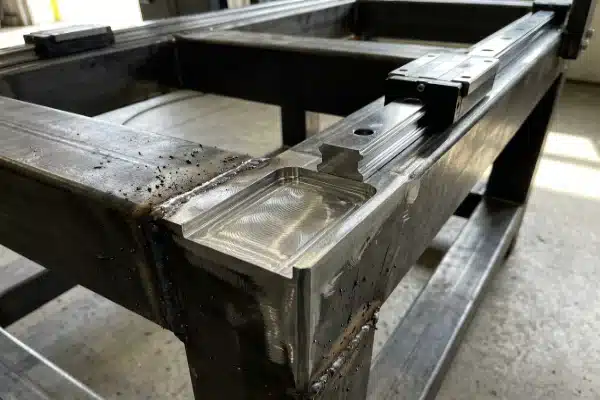
Verify that rail mounting surfaces show clear milling marks, proving they were machined flat after welding to prevent binding. Furthermore, examine the base design for diagonal torque bracing to counteract twisting forces and ensure accessible service windows exist for bottom-mounted servo motors.
A robust frame is not just about heavy steel; it is about smart engineering. The forces in an all-electric machine are different, and the maintenance requirements are unique.
Invisible cold cracks 9
Verify Machined Rail Surfaces (Not Just Welded)
All-electric machines rely on high-precision linear guides for carriage movement.
- The Wrong Way: Welding the frame and then bolting the linear rails directly to the raw, welded steel surface. Welding warps steel. The rail will twist, causing the carriage to bind and burn out the servo motor.
- The Right Way: Look closely at the metal under the rails. You must see milling marks (swirls or lines from a CNC cutter). This proves the manufacturer placed the huge frame onto a gantry milling machine after welding and annealing to create a perfectly flat reference plane.
Diagonal "Torque Bracing"
Hydraulic rams push in a straight line. Servo motors, however, generate immense rotational torque.
- When a servo accelerates the carriage, it tries to twist the frame.
- Look for diagonal gussets or X-bracing near the motor mounts.
- A frame designed for hydraulics (often just parallel beams) is insufficient for electric drives. Without diagonal bracing, the torque will eventually crack the welds near the motor mount.
Review the FEA Stress Report
Don’t just take their word for it. Request the Finite Element Analysis (FEA) report.
- What to look for: The "Safety Factor" map.
- Key Area: Look at the platen supports.
- The "Jerk" Factor: Ensure the analysis accounts for the specific "jerk" (rate of change of acceleration) of electric braking. A frame that passes a static load test might fail under the dynamic "snap" of a servo stopping instantly.
Accessibility for Servo Maintenance
Finally, consider the human element. Unlike hydraulic cylinders which are often on top, electric drives are frequently buried in the base to lower the center of gravity.
- The Test: Ask the manufacturer, "If I need to change the carriage motor belt, how do I reach it?"
- Requirement: There must be dedicated service windows or cutouts in the frame.
- If you have to disassemble the entire guarding or lift the machine to reach a belt tensioner, the frame design is a failure in operational robustness.
Frame Design Feature Checklist
| Característica | Función | How to Verify |
|---|---|---|
| Milled Rail Seats | Ensures linear guides sit flat. | Visual check for CNC tool marks under rails. |
| Torque Gussets | Resists servo rotational twisting. | Look for diagonal steel plates near motor mounts. |
| Service Cutouts | Allows access to buried motors. | Physical check: Can you reach the belt tensioner? |
| FEA Report | Validates design against stress. | Request document; check "Safety Factor" > 2.0. |
Conclusión
Verifying a machine frame requires looking beyond the fresh paint. By inspecting weld integrity with Dye Penetrant, measuring steel thickness, and validating rigidity through vibration and elongation tests, you ensure your investment rests on a solid foundation.
inspecting weld integrity 10
Notas al pie
- Official government regulations regarding required machine safety barriers. ↩︎
- Educational resource from MIT covering fundamental materials science concepts. ↩︎
- General engineering concept explanation for structural safety margins. ↩︎
- Government authority on measurement science and calibration standards. ↩︎
- General background definition of servomotor technology and characteristics. ↩︎
- Product documentation from a primary manufacturer of linear motion systems. ↩︎
- Technical overview of vibration sensing from a major accelerometer manufacturer. ↩︎
- Leading manufacturer documentation explaining how ultrasonic gauges measure thickness. ↩︎
- Authoritative industry resource explaining the formation and risks of cold cracks in welding. ↩︎
- Links to the official ISO standard for dye penetrant testing protocols. ↩︎


0 Comentarios