

How do I choose, maintain, and troubleshoot blow molding die heads?

At our factory, we often see production lines halted simply because the die head configuration doesn’t match the bottle design. This mismatch kills your efficiency and spikes material waste. (Max 30 words)
material waste 1
Select a die head by calculating the Blow-Up Ratio (BUR) between 1:2.5 and 1:3.0, ensuring the tooling diameter matches your bottle design. Prevent carbon buildup through weekly brass-tool cleaning, and fix curling by balancing heater band temperatures rather than just mechanically shifting the die ring.
Let’s explore the technical specifics of die head selection and maintenance to help you optimize your production line.
How do I select the right die head for my specific bottle design?
When we engineer machines for clients, sizing the die head incorrectly is the most frequent mistake we encounter. It leads to weak bottle corners and creates unnecessary scrap. (Max 30 words)
weak bottle corners 2
To select the correct die head, calculate the die diameter based on the target bottle weight and required Blow-Up Ratio (BUR). For optimal wall distribution and impact strength, maintain a BUR between 1:2.5 and 1:3.0, and adjust the Land Length to control die swell stability.

Understanding Die Swell and BUR
Selecting the right die head isn’t just about picking a size that fits the machine; it is about physics. At LEKA Machine, we start every project by calculating the Blow-Up Ratio (BUR). This ratio represents the expansion of the parison (the plastic tube) to the final bottle diameter.
If your BUR is too low (under 1:1.5), you waste material because the parison is too thick. If it is too high (over 1:3.0), the plastic stretches too thin, causing corner webbing and weak spots.
The Formula We Use
To find the right tooling size, use this logic:
- Determine Bottle Diameter: The widest part of your container.
- Apply Target BUR: Divide the bottle diameter by your target BUR (aim for 2.5 or 3.0).
- Result: This gives you the required die diameter.
Shape Matters: Ovalization and Land Length
For round bottles, standard tooling works well. However, if you are producing flat or rectangular containers (like jerry cans), standard round tooling causes thin corners. In these cases, we use "Ovalized" tooling. We machine the die bushing into an oval shape to direct more plastic flow into the areas that will stretch the furthest (the corners).
Additionally, you must consider the "Land Length"—the straight section at the tip of the die pin.
- Longer Land: Increases back-pressure. We use this for precision necks to reduce swelling.
- Shorter Land: Increases output rate. We use this for high-speed production where precision is less critical.
Spider vs. Spiral Design
Finally, the internal structure of the head matters based on your resin.
| Característica | Spider Die Head | Spiral Mandrel Die Head |
|---|---|---|
| Best Material | PVC (Heat Sensitive) | HDPE / PP (Polyolefins) |
| Flow Mechanics | Splits flow (Low Back-Pressure) | Overlaps flow (High Mixing) |
| Weld Lines | Risks vertical weld lines | Eliminates weld lines completely |
| Fuerza | Moderado | High (Best for drop tests) |
| Color Change | Rápido | Slower (harder to flush) |
What are the best practices for cleaning my die head to prevent carbon buildup?
We often see "die lines" on customer samples caused by improper cleaning tools used during maintenance. Scratched chrome plating is permanent, forcing expensive tooling replacements and downtime. (Max 30 words)
Prevent carbon buildup by implementing a "Sealing" procedure with low-MFI shutdown resin before turning off heaters to block oxygen. When manual cleaning is necessary, strictly use brass or copper tools to remove degraded plastic, as steel scrapers will scratch the chrome plating and ruin surface finish.

The "Soft Tool" Rule
The most expensive mistake operators make is using steel screwdrivers or scrapers to clean a die head. The die head surfaces are often chrome-plated for smoothness. Even a microscopic scratch from a steel tool will create a permanent "die line" (a vertical streak) on every bottle you produce.
At our facility, we strictly enforce the "Brass Tool" Protocol. We only use tools made of brass, copper, or hardwood. These materials are harder than the plastic residue but softer than the die steel. This ensures that we remove the carbon without damaging the critical flow surfaces.
Shutdown Purging Strategies
Carbon buildup usually happens when the machine is turned off, not when it is running. When the machine cools down, oxygen attacks the static plastic inside the head, turning it into hard carbon.
To stop this, we use a "Sealing" procedure:
- Do not just turn off the heaters.
- Purge the head with a high-stability, low-MFI (Melt Flow Index) shutdown resin or a commercial purge compound.
- Seal the die gap completely.
This process effectively air-seals the internal channels, preventing oxidation while the machine is off.
EVOH 3
Die Lip Radius Trade-off
When cleaning, inspect the die lip (the exit edge). The geometry here dictates your surface quality.
- Sharp Die Lip: Gives a clean cutoff but can cause "melt fracture" (sharkskin effect) at high speeds.
- Radiused (Rounded) Lip: Smooths the surface but encourages "die drool." This is where material accumulates on the face, chars, and eventually falls onto your fresh bottles as black specks.
Cleaning Protocol Checklist
| Step | Action | Tool/Material | Why? |
|---|---|---|---|
| 1 | Heat Soak | Heater Bands | Softens plastic for removal. |
| 2 | Bulk Removal | Copper Scraper | Removes 90% of material without scratching. |
| 3 | Detail Cleaning | Brass Wool / Gauze | Polishes surfaces; removes oxidation. |
| 4 | Final Wipe | Cotton Cloth | Removes dust and oil. |
| 5 | Assembly | Llave dinamométrica | Ensures even pressure to prevent leaks. |
How can I fix parison curling or uneven wall thickness in my production?
During factory acceptance tests, a curling parison is a nightmare for operators trying to calibrate the mold. It usually signals thermal instability rather than mechanical misalignment. (Max 30 words)
virgin HDPE 4
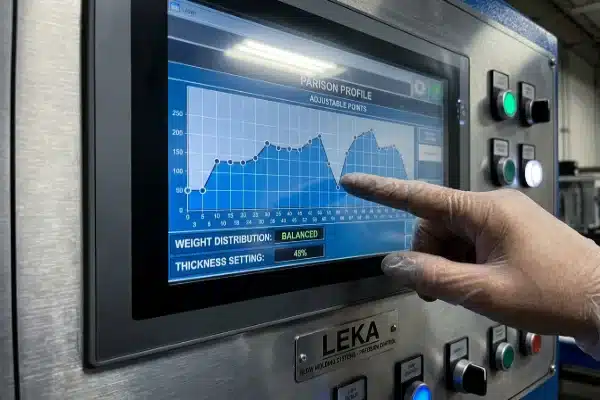
Fix parison curling by first adjusting the heater band temperatures on the side opposite the curl to balance flow velocity. To resolve uneven wall thickness, utilize a Weight Distribution System (WDS) or electronic parison programmer to dynamically vary the die gap and push material into high-stretch areas.
Thermal vs. Mechanical Adjustment
When a parison curls (hooks) to the left, the natural instinct is to grab a wrench and shift the die ring to the right. We advise against doing this immediately.
Curling is often caused by temperature imbalances. Hot plastic flows faster; cold plastic flows slower. If one side of your die head is 5°C hotter than the other, the plastic on the hot side will exit faster, causing the tube to curl away from that side.
La solución: Before moving bolts, check your heater bands. If the parison curls left, the right side might be too hot (flowing too fast) or the left side too cold. Adjust the temperature on the side opposite the curl to balance the flow velocity.
Weight Distribution System (WDS)
For uneven wall thickness—such as thin corners or heavy bottoms—a static die gap is not enough. You cannot fix complex bottle issues with a single gap setting.
Nosotros utilizamos Electronic Parison Programming (WDS). This system breaks the parison extrusion into 30 or 100 points. It uses a servo to lift and lower the mandrel during the extrusion of a single shot.
- Thin Corners? Program the WDS to open the gap wider at the specific point in the parison that forms the corners.
- Heavy Bottom? Program the WDS to close the gap slightly as the bottom is extruded to save material.
Troubleshooting Common Defects
| Defecto | Likely Cause | Solución |
|---|---|---|
| Parison Curling | Uneven Head Temp | Balance heater bands; check for burnt-out heaters. |
| Parison Curling | Die Ring Misalignment | Mechanically center the die ring (only after checking temps). |
| Sharkskin | Melt Fracture | Increase die temp; smooth the die lip radius. |
| Die Lines | Dirty/Damaged Tooling | Disassemble and clean with brass tools; polish scratches. |
| Paredes irregulares | Parison Sag (Gravity) | Increase extrusion speed; use WDS to thicken the top. |
Should I invest in a multi-layer die head for better cost efficiency?
Many clients hesitate at the upfront cost of multi-layer heads. However, running 100% virgin material is often financial suicide in competitive markets like detergent or industrial chemicals. (Max 30 words)
melt fracture 6
Investing in a multi-layer die head is highly cost-efficient for high-volume production, as it allows sandwiching cheap Post-Consumer Recycled (PCR) material between thin virgin layers. This "cost-averaging" strategy reduces raw material expenses by 30–40% while maintaining the cosmetic appearance and regulatory compliance of virgin plastic.

The "Cost-Averaging" Strategy
A multi-layer die head (Co-Ex) is the single most effective tool for long-term profit. While the initial investment is higher than a mono-layer head, the ROI is rapid if you have high output.
The strategy is simple: Hide the cheap material.
We design heads that create a 3-layer sandwich:
- Outer Layer (20%): Virgin Masterbatch (Pure color, perfect finish).
- Middle Layer (60%): PCR / Regrind / CaCO3 Filler (Cheap, ugly, structural).
- Inner Layer (20%): Virgin Material (Chemical resistance, clean).
This allows you to use up to 60% low-cost material without the customer ever seeing it. The bottle looks perfect on the shelf, but costs significantly less to make.
Melt Flow Index 8
When to Upgrade
If you produce fewer than 500 bottles a day, a mono-layer head is fine. The complexity isn’t worth it. However, for continuous production, the math changes.
Consider the cost of resin. If virgin HDPE is $1.20/kg and PCR is $0.70/kg, a multi-layer machine saves you $0.30 per kg of finished product. On a machine processing 100kg/hour, that is $30/hour pure profit—or roughly $180,000 per year in savings on a 6,000-hour production schedule.
physics 9
Technical Considerations
Moving to multi-layer is not just about buying a head. You need:
- Additional Extruders: One for each layer.
- Complex Flow Channels: The die head must merge the streams without mixing them.
- Compatibility: The materials must adhere to each other. HDPE bonds well with HDPE PCR. However, if you add a barrier layer like EVOH (for oxygen barrier), you need a 5-layer or 6-layer head to include adhesive tie-layers.
Conclusión
Choosing the right die head, maintaining it with soft tools, and leveraging multi-layer technology determines your profitability. Contact us to optimize your specific configuration. (Max 30 words)
die head configuration 10
Notas al pie
- Government statistics on plastic material waste and recycling rates. ↩︎
- Standard test method for drop impact resistance of blow molded containers. ↩︎
- Overview of the barrier properties of Ethylene Vinyl Alcohol. ↩︎
- Major supplier of high-density polyethylene resins for blow molding. ↩︎
- Technical specifications from a major industrial heater manufacturer. ↩︎
- Definition of the specific polymer flow instability defect. ↩︎
- OSHA safety standards for hazardous energy control during machine maintenance. ↩︎
- International standard (ISO 1133) for testing thermoplastic melt flow rates. ↩︎
- Educational resource on polymer viscoelasticity and flow mechanics. ↩︎
- Leading manufacturer of precision extrusion die heads. ↩︎


0 Comentarios