
How Should I Evaluate the Stability of the Supplier’s Supply Chain?
At our factory, we know that a high-tech machine is useless if you cannot get parts. Buyers often fear downtime, but overlooking the supply chain creates that exact risk. We see that evaluating supplier reliability is as critical as checking clamp force.
To evaluate supply chain stability, audit the supplier’s financial health and component sourcing strategy. Verify they use globally available brands for servos, maintain a documented "Crash Kit" inventory, and possess a transparent tracking system for long-lead items to ensure rapid recovery during unexpected failures.
Let’s break down the critical questions you must ask to avoid buying a machine that becomes an orphan in your factory.
Are the servo motors and drives sourced from globally recognized brands?
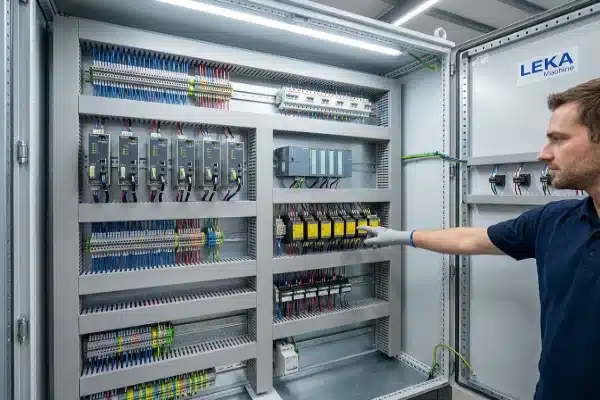
When we design our all-electric LEKA machines, we prioritize components you can source locally. Relying on obscure proprietary brands or rebranded "black box" electronics is a recipe for extended production halts that we strive to avoid for our partners.
You must confirm that the servo motors and drives come from Tier-1 global manufacturers like Siemens, B&R, or Beckhoff. These brands offer local support networks and standardized protocols, ensuring that if a drive fails, you can find a replacement distributor in your region without waiting weeks.
The Risks of "Black Box" Electronics
In the all-electric extrusion blow molding 1 (EBM) sector, the temptation for manufacturers to use lower-cost, domestic servo brands is high. While these may function well initially, they pose a significant long-term supply chain risk. If a supplier uses a proprietary or "white-labeled" drive (where the manufacturer’s name is hidden), you become 100% dependent on them for replacements.
If that supplier goes out of business or changes their product line, your machine becomes obsolete instantly. We recommend conducting a "Local Availability Test." Before signing a contract, take the part numbers of the servo motors and drives 2 listed in the quote and call a local distributor in your country. If the local distributor says, "We don’t carry this," or "This is a custom part restricted to the OEM," your risk profile increases dramatically.
Critical Component Brand Evaluation
Use the following table to evaluate the safety of the components listed in your machine quotation.
| Component Category | Low Risk (Preferred) | High Risk (Avoid) | Why it Matters? |
|---|---|---|---|
| Servo Motors | Siemens, Beckhoff, Rexroth, Omron, Yaskawa | Rebranded OEM motors, obscure regional brands | Local tech support and firmware compatibility are essential for future repairs. |
| PLC / Controller | B&R, Beckhoff, Rockwell (Allen-Bradley), Siemens | Proprietary PCB boards, "Black Box" controllers | Proprietary boards cannot be repaired by third parties; global PLCs have long lifecycles. |
| Linear Guides | THK, Hiwin, Bosch Rexroth | Unbranded / Copycat rails | Standard sizing allows for easy interchangeability if the original supplier delays shipping. |
| Pneumatics | Festo, SMC, Parker | Domestic "No-Name" valves | Air leaks cause quality issues; you need standard ISO valve sizes for quick swaps. |
Evaluating the Tier-2 Supply Chain
You are not just buying from the machine builder; you are buying from su suppliers. A stable machine builder maps their Tier-2 and Tier-3 sources. Ask the manufacturer if they have single-source vulnerabilities. For example, if they rely on a single factory for their heavy-duty ball screws, a disruption there halts your machine delivery. We find that transparent manufacturers are willing to disclose their key component partners because it builds trust.
How does the supplier manage inventory for critical long-lead components?
Our procurement team learned early on that "just-in-time" manufacturing can be dangerous for spare parts. just-in-time manufacturing 3 Delays in receiving raw materials can leave your production line stranded, so we emphasize physical stock over digital promises.
Ask your supplier for real-time proof of their critical spares inventory specifically for your machine model. A reliable partner maintains a physical stock of long-lead items, such as specialized gearboxes or heavy-duty servo motors, protecting you from the volatile 12-week lead times common in global supply chains.

The Difference Between "Virtual" and "Physical" Stock
Many suppliers claim to have "full stock," but they often rely on their vendors’ inventory. This is virtual stock. In a global supply chain crisis (like the chip shortages we have seen recently), virtual stock disappears. You need to verify that the supplier holds physical stock of the "Crash Kit" components—the parts that stop the machine if they fail.
Financial Health and Inventory Depth
Holding inventory requires cash. A supplier with poor cash flow cannot afford to keep $50,000 worth of servo drives sitting on a shelf. Therefore, assessing a supplier’s inventory is also an indirect way of auditing their financial health. Review their ability to sustain long-term partnerships without insolvency risks. If they are operating "hand-to-mouth," they will order your replacement part only after you pay them, adding weeks to the lead time.
Recommended "Crash Kit" vs. Consumables
A robust supply chain strategy divides parts into two categories. You should ask the supplier for their management policy on both.
| Inventory Type | Definition | Example Parts | Supplier Responsibility |
|---|---|---|---|
| Consumables | Parts that wear out predictably. | Heater bands, thermocouples, blow pins, cutting knives. | Should be available for immediate dispatch (24 hours). |
| Crash Kit (Critical) | Parts that rarely fail but stop production if they do. | Main servo motor, Parison programmer valve, PLC CPU. | Supplier should hold at least 1 unit per 5 machines sold; Buyer is advised to hold 1 set on-site. |
| Structural | Custom machined parts. | Platens, tie-bars, clamp toggles. | Supplier must have raw material sourcing and digital drawings ready for rapid machining. |
Redundancy and Continuity Plans
Does the supplier have a disaster recovery plan? If their main warehouse floods or faces a labor strike, how do they ship parts? We suggest asking if they have redundant manufacturing capabilities or multiple warehouse locations. This is particularly important for export markets. For instance, a supplier in China should ideally have a service center or a partner warehouse in Europe or North America to buffer against shipping delays.
What is the current lead time for replacement parts if a major component fails?
Our service team knows that every hour of downtime costs you profit. We measure our success not just by machine cycle speed, but by how fast we can ship a replacement module to get you back online.
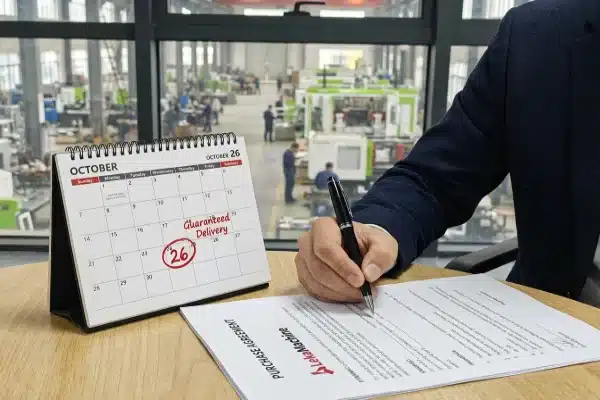
Demand a contractual commitment regarding lead times for proprietary and standard parts. The supplier should provide a categorized list defining which parts ship within 24 hours and which require fabrication, along with a defined escalation protocol for emergency air freight to minimize your operational losses.
Logistics and the "Last Mile" Problem
Even if the part is on the shelf, getting it to your factory is a logistics challenge. International shipping involves customs, tariffs, and potential border delays. You should evaluate the supplier’s experience with DDP (Delivered Duty Paid) shipping. Can they handle the customs clearance for you, or will the part sit at the airport for three days while you scramble for paperwork?
Analyzing Delivery Performance History
Don’t just take their word for it. Ask for data on their On-Time In-Full (OTIF) percentage for spare parts over the last 12 months.
- High Stability: >95% OTIF for spares.
- Moderate Stability: 80-95% OTIF.
- Risk: <80% implies their logistics or inventory management is disorganized.
Geopolitical and Trade Risks
In today’s global economy, trade policies change rapidly. Tariffs or trade wars can suddenly double the cost of a part or triple its lead time. A stable supplier analyzes these risks and has contingency plans. For example, if direct export becomes difficult, do they have a third-party distributor in a neutral region? Evaluating the supplier’s exposure to these geopolitical risks is crucial for long-term machine ownership.
Service Level Agreements (SLAs)
We recommend incorporating a Service Level Agreement 4 into your purchase contract. This defines the "Clock Start" to "Clock Stop" for support.
- Response Time: How long until an engineer answers the phone? (Target: <4 hours).
- Diagnosis Time: How long to identify the part number? (Target: <24 hours).
- Dispatch Time: How long until the part leaves the dock? (Target: <24 hours for stock items).
Without these definitions, "We will send it soon" is too vague to protect your business.
Conclusión
Evaluating supply chain stability 5 requires looking beyond the machine’s steel and into the supplier’s logistics and financials. By insisting on global component brands, verifying physical inventory of critical spares, and establishing clear lead-time contracts, you protect your production from extended downtime. A reliable partner doesn’t just sell you a machine; they guarantee the ecosystem that keeps it running.
Notas al pie
- Offers a comprehensive overview of extrusion blow molding, a key manufacturing process. ↩︎
- Provides a clear explanation of servo motors and their fundamental working principles. ↩︎
- Provides a clear and concise definition of just-in-time manufacturing from a reputable technology information source. ↩︎
- Provides a clear and concise definition of a Service Level Agreement from an authoritative source. ↩︎
- Defines supply chain stability and its importance for business operations. ↩︎


0 Comentarios