





¿Una máquina de moldeo por soplado totalmente eléctrica más pesada garantiza una mejor estabilidad y rendimiento?
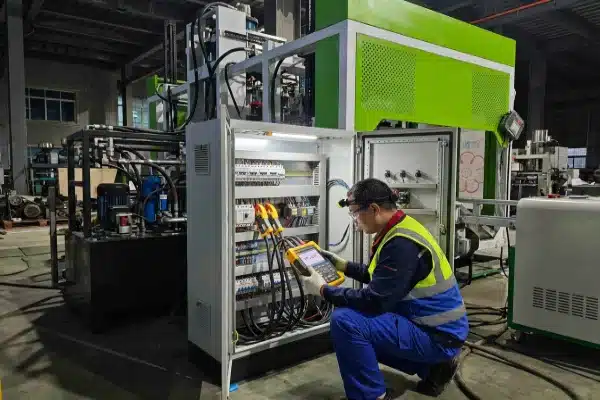
When we design our machinery at LEKA Machine, we often encounter customers who equate the sheer physical weight of a machine with its quality. It is a common misconception that a heavier machine automatically implies a sturdier, longer-lasting investment.
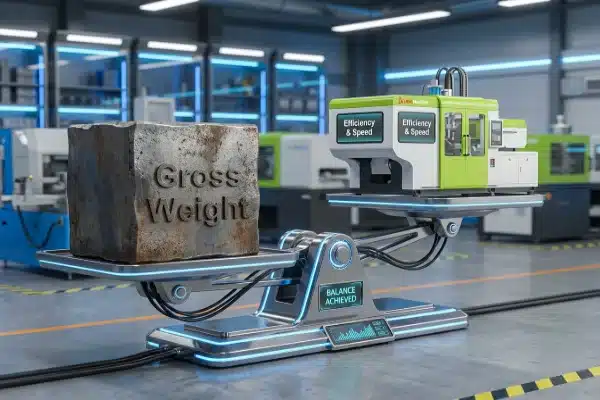
However, simply looking at the gross weight on a specification sheet can lead you down a dangerous path. If you choose a machine based solely on mass, you risk purchasing outdated technology that consumes more power and reacts sluggishly.
Weight alone is a misleading indicator of quality. While a heavy stationary base provides essential stability, excessive weight in moving parts acts as parasitic mass, reducing energy efficiency and slowing down servo response times. You must analyze where the weight is located.
So, how do you distinguish between "good weight" and "bad weight"? In the following sections, we break down exactly what the numbers on the spec sheet mean for your production speed, wallet, and long-term machine durability.
How should I interpret weight differences when comparing different brands of all-electric extrusion blow molding machines?
In our experience exporting to markets like North America and Europe, we find that shipping costs make weight a sensitive topic. However, cutting weight indiscriminately is not the answer either. When we calibrate our flight controllers and servo drives 1, we see firsthand how mass affects performance. A machine that is too light may vibrate, while one that is too heavy becomes lethargic. You need to know how to spot the difference between structural integrity and inefficient design.
To correctly interpret weight differences, assess the ratio between static and dynamic mass. A superior machine features a heavy, vibration-damping base but utilizes lightweight, high-tensile alloys for moving platens. This combination ensures stability without sacrificing speed, precision, or regenerative energy capabilities.
Understanding the engineering behind machine weight requires looking inside the covers. It is not just about how much steel is there, but how that steel is used. Below, we dive deep into the specific areas where weight impacts your daily operations.
The Critical Distinction: Moving Mass vs. Static Mass
The most important concept to grasp is the difference between the parts that stay still and the parts that move. In our engineering meetings, we refer to heavy moving parts as "parasitic mass."
In an all-electric machine, the servo motors must accelerate and decelerate the mold carriage thousands of times a day. If the carriage is unnecessarily heavy, the motors have to work much harder. This kills your acceleration speed. A lighter carriage, designed with high-strength alloys and Finite Element Analysis (FEM) 2, allows for snappy, precise movements. Conversely, the stationary base needs mass. A heavy base anchors the machine and absorbs the energy created by the moving parts.
H3 – The Impact of "Parasitic Mass" on Servo Performance
| Característica | Low Moving Mass (Optimized) | High Moving Mass (Unoptimized) |
|---|---|---|
| Acceleration | Rapid, snappy response (<0.1s) | Sluggish, requires ramp-up time |
| Recuperación de energía | High regenerative braking efficiency | Kinetic load overpowers capacitors |
| Motor Strain | Low, runs cooler | High, risk of overheating |
| Duración del ciclo | Optimized for high speed | Limited by inertia |
Vibration Damping and Frame Materials
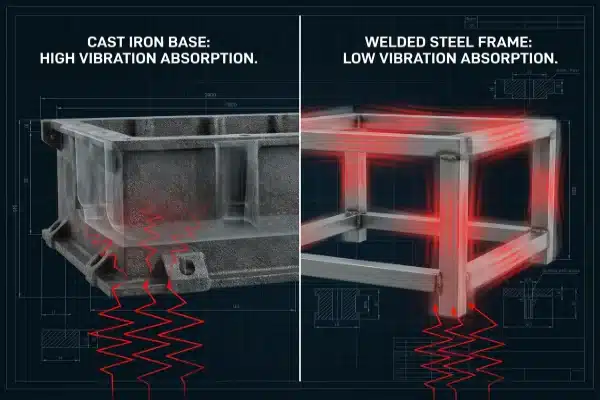
Customers often ask if a lighter machine will "walk" across the floor or vibrate excessively. This depends on the material, not just the weight. Cast iron 3 is heavy, but it has excellent damping properties—up to 10 times better than welded steel. It absorbs the high-frequency "jerk" vibrations caused by servo braking.
However, do not assume a lighter machine is weak. We use FEM to simulate stress points. A lighter machine using "ribbed" geometry and high-tensile alloys can actually be stiffer than a heavy machine made of cheap, thick mild steel plates.
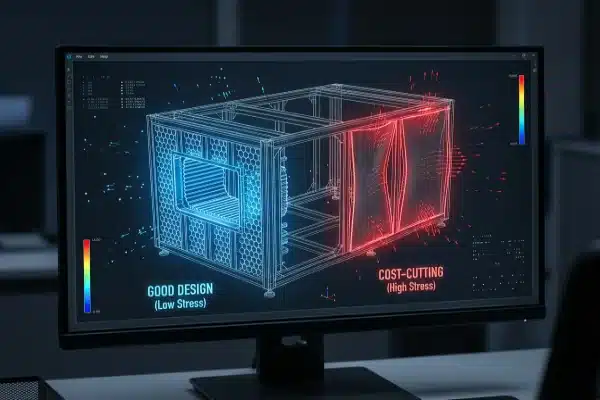
If a supplier uses thick plates just to add weight, they are engaging in "weight padding." This creates a false sense of robustness without adding structural rigidity where it counts.
H3 – Thermal Stability and Warm-Up Times
One hidden downside of massive cast iron clamping units is thermal inertia 4. Heavy metal acts like a heat sink. It takes a long time to absorb heat and reach a stable temperature.
- Warm-up Phase: A heavy machine may take 2-3 hours to reach thermal equilibrium 5.
- Drifting: During this time, the metal expands. This causes your mold alignment to drift. You might spend the first few hours of the shift constantly adjusting settings to keep the bottles within spec.
- Lighter Machines: Reach operating temperature faster, meaning you get good bottles sooner.
The "Regenerative Braking" Penalty
All-electric machines are marketed as "Green" technology. They save energy by recovering power when the mold closes or slows down, similar to regenerative braking 6 in electric vehicles.
If the moving platens are too heavy, the kinetic energy generated during movement is too high. The capacitor bank in the drive system cannot handle it. Instead of recycling that energy back into the grid or the machine, it is wasted as heat through braking resistors 7. Therefore, a heavier machine can actually be less energy-efficient than a lighter, optimized counterpart.
H3 – Identifying Cost-Cutting vs. Engineering
You must be vigilant about why a machine is light. Is it light because of smart engineering, or because the manufacturer cut costs?
| Indicador | Good Lightness (Engineering) | Bad Lightness (Cost-Cutting) |
|---|---|---|
| Frame Design | Triangular bracing, ribbed structures | Thin sheet metal skins, no bracing |
| Materiales | High-tensile alloys, aluminum components | Standard mild steel, just thinner |
| Tecnología | FEM optimized geometry | Simply removed material to save money |
| Resultado | High stiffness, low inertia | Frame twist, mold misalignment |
Tie-Bar Elongation and Flash
There is one area where you generally want more mass: the clamping unit’s tie-bars 8 and platens. When the mold closes under tons of pressure, the platens naturally want to bow outwards.
If the platens are too thin (too light), they will bow. This causes the mold to open slightly in the center, leading to parting-line flash 9.
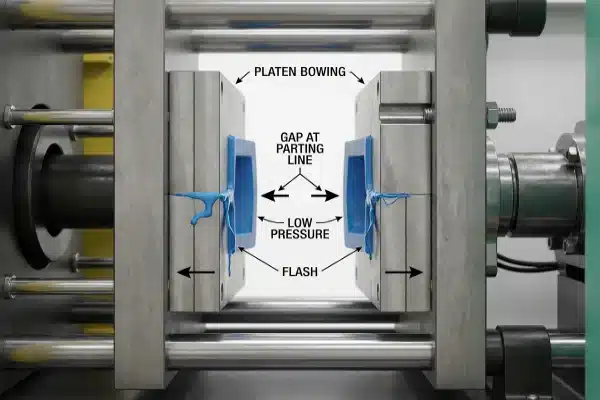
In our testing, we have found that adding functional mass here is necessary to minimize tie-bar stretch. However, this must be balanced. The goal is stiffness, not just dead weight.
Logistical and Infrastructure Implications
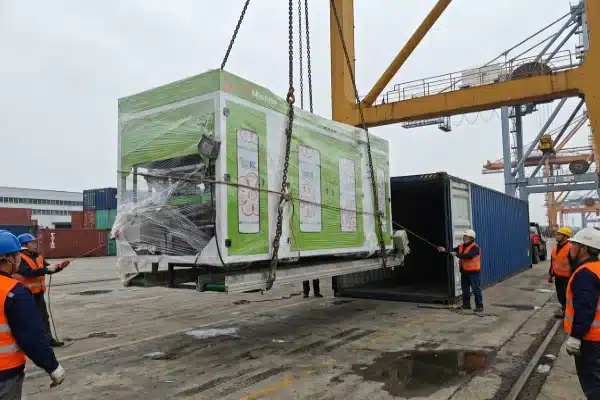
Finally, consider how the weight affects your facility. A significantly heavier machine might exceed the floor loading limits of a standard shipping container. This forces you to pay for expensive Flat Rack shipping 10. Once it arrives, does your factory floor need reinforced concrete pads? A heavier machine requires a more expensive foundation to prevent settling over time, which can twist the frame and ruin alignment.
Conclusión
Interpreting weight is about balance. You want a heavy, stable base for vibration damping, but lightweight, stiff moving parts for servo efficiency. Do not judge a machine by its gross tonnage alone; look for the engineering intent behind the mass.
Notas al pie
1. Overview of servo drive technology used in industrial automation. ↩︎
2. Explanation of Finite Element Method for simulating physical stress. ↩︎
3. Properties of cast iron relevant to damping capacity. ↩︎
4. Engineering definition of thermal inertia in materials. ↩︎
5. State where a system reaches stable temperature distribution. ↩︎
6. Mechanism for recovering kinetic energy as electricity. ↩︎
7. Function of resistors in dissipating excess motor energy. ↩︎
8. Role of tie-bars in heavy machinery clamping units. ↩︎
9. Causes and definitions of flash defects in molding. ↩︎
10. Specifications and uses for flat rack shipping containers. ↩︎


0 Comentarios