
At our factory, we know that buying an all-electric EBM machine 1 is a massive capital investment. You naturally worry that technology will outpace your purchase, leaving you with obsolete equipment. We see this anxiety often, and it is entirely preventable with the right questions OPC UA 2.
To secure future value, you must negotiate specific provisions for PLC scalability, electrical cabinet space for new servos, and mechanical frame durability. Demand contractual guarantees for software updates and retrofit kit availability to ensure your machine adapts to changing market demands over its twenty-year lifecycle.
Let’s break down the specific technical questions you need to ask your supplier to future-proof your production line Service Level Agreement 3.
Can the current PLC system support future software updates and new feature additions?
Our engineers often see clients struggle with outdated controllers that cannot handle modern demands. This creates a technical bottleneck that stifles your factory's growth potential and prevents you from adopting new efficiency tools.
A future-proof PLC must possess excess CPU capacity and solid-state memory to handle complex algorithms and newer IIoT protocols like OPC UA. You should verify that the controller uses standardized hardware from global vendors to prevent proprietary lock-in, ensuring easy software integration and long-term support.
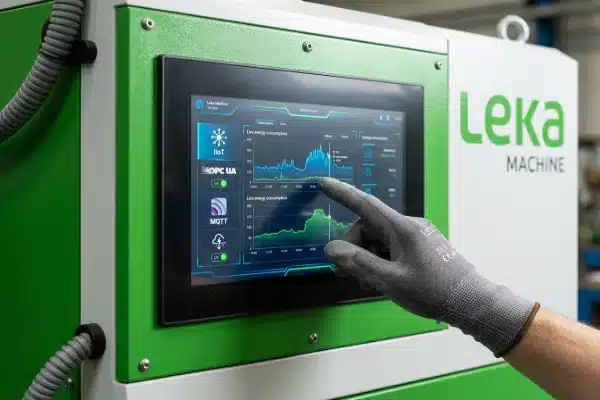
El Programmable Logic Controller (PLC) 4 is the brain of your all-electric machine. While the steel frame may last twenty years, the digital landscape changes every few years. When we design our systems, we prioritize computational scalability. You need to ask your supplier if the CPU load is currently maxed out or if there is significant "headroom" for future logic.
Computational Scalability and Architecture
A modern machine must do more than just open and close molds. Future updates might require the PLC to handle complex parison control loops (up to 100 points), monitor energy consumption in real-time, or integrate with a factory-wide Manufacturing Execution System (MES). If the processor is running at 90% capacity on day one, you have zero room for these additions. We recommend insisting on controllers from widely supported vendors like Beckhoff or Siemens. This avoids the trap of "proprietary lock-in," where you are forced to pay exorbitant fees for simple updates because only the OEM can access the code.
Connectivity Protocols
The industry is moving toward smart factories. Your machine needs to speak the universal languages of the Industrial Internet of Things (IIoT) 5. We utilize two main protocols, and you should ensure your supplier supports them:
| Protocol Architecture | Primary Functionality | Ideal Implementation |
|---|---|---|
| OPC UA | Semantic modeling and complex machine browsing. | Best for local machine-to-machine (M2M) integration and internal SCADA systems. |
| MQTT | Lightweight telemetry and fast event-driven data streaming. | Best for sending large amounts of data to cloud platforms for remote diagnostics. |
| Sparkplug B | Adds context to MQTT data. | Ensures your data is organized when it reaches the analytics dashboard. |
By securing these capabilities now, you ensure that a simple software update in five years won't require ripping out the entire control hardware.
Is there physical space in the electrical cabinet for adding extra servo drives later?
When we build machines, we prioritize layout logic, but many suppliers pack cabinets too tightly to save on sheet metal costs. This makes adding auxiliary equipment later nearly impossible without a complete and expensive overhaul.
You must confirm that the electrical cabinet reserves at least 20% to 30% of DIN rail space and back-panel real estate for future drives. Additionally, the cooling system must be over-engineered to dissipate the heat generated by these potential add-ons, preventing thermal failure.
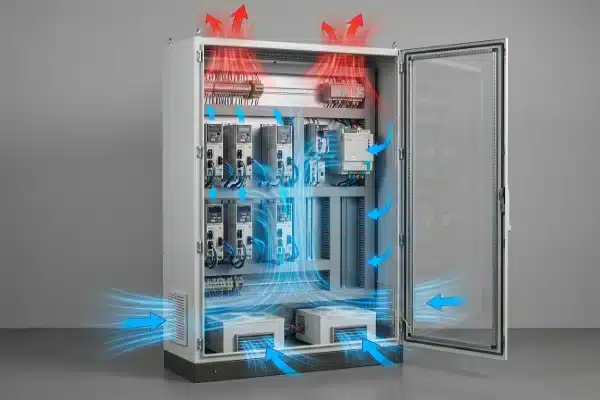
An all-electric blow molding machine relies on a network of servo motors for everything from carriage shuttling to parison control. As your business grows, you may want to add a robot for automatic part take-out, a post-cooling station, or a leak tester. All of these require additional drives and I/O modules. If your cabinet is packed like a sardine can, you are stuck.
The Importance of Volumetric Capacity
We strongly advise you to open the cabinet drawings before signing the contract. Look for empty DIN rail space. A good rule of thumb is to request a "reserve capacity" of 20% to 30%. This allows your maintenance team to safely install new Variable Frequency Drives (VFDs) or servo amplifiers without creating a rat's nest of wiring. High-voltage components must remain physically separated from low-voltage logic to prevent signal interference, so this extra space is also a safety requirement.
Managing Thermal Headroom
Space is not the only constraint; heat is the silent killer of electronics. Every servo drive generates heat—approximately 3% of its kilowatt rating is lost to the environment. If you add three new heavy-duty servos in the future, the heat load in the cabinet increases significantly.
| Cabinet Variable | Day-One Engineering Provision | Future Mitigation Strategy |
|---|---|---|
| Physical Space | 20-30% reserved rail space. | Avoids need for external sub-panels. |
| Thermal Load | Oversized active HVAC units. | Prevents thermal throttling of new drives. |
| EMI Management | Segregated cable raceways. | Protects new signals from noise corruption. |
Ask your supplier for engineering calculations that prove the installed air conditioning or heat exchangers can handle the future maximum load, not just the current load. Without this, your upgraded machine will overheat and shut down during summer months.
How do I ensure the machine frame can accommodate larger molds or more cavities in the future?
We design our clamping units to be robust, but upgrading later is physically demanding on the equipment. If you choose a weak frame now to save money, you cannot simply bolt on larger molds later without risking catastrophic mechanical failure.
Ensure the machine frame and clamping mechanism have sufficient structural yield strength to handle increased cavitation. You need a modular design with standardized tooling interfaces and over-engineered kinematic linkages that can withstand the higher dynamic loads of faster, more powerful servo upgrades.
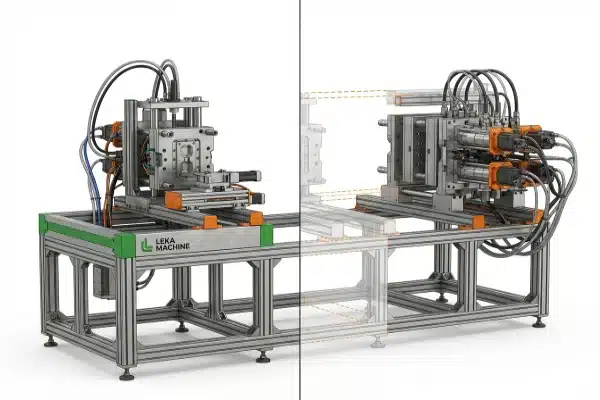
The mechanical frame is the skeleton of your operation. Unlike software, you cannot download a stronger frame. If you plan to move from a single-cavity mold to a 4-cavity setup to double your output, the machine must be physically capable of handling it.
Kinematic Frame Modularity
You need to verify the maximum clamping force. For example, moving from a small cosmetic bottle to a larger jerry can increases the surface area significantly. The internal blowing pressure will try to force the mold open. If your clamp tonnage is insufficient, you will get "flash" (excess plastic) on every parting line. We suggest looking for modular shuttle concepts. These allow a central extruder to serve multiple carriage stations. This means you could potentially expand production capacity up to 90,000 bottles per hour by upgrading the carriage modules without scrapping the main machine.
Mechanical Wear Compensation
Here is a critical insight many buyers miss: Speed kills weak mechanics. You might upgrade to a faster servo motor in five years to reduce cycle time by 10%. However, if the ball screws, linear guides, and toggle mechanisms were not designed for that higher velocity and jerk force, they will wear out in months.
Standardized Tooling Interfaces
Finally, consider the changeover time. If you move to multi-cavity production, the complexity of cooling and pneumatic connections triples.
- Manifolds: Does the machine have universal manifold blocks?
- Mounting: Are there standardized quick-change interfaces?
If the machine uses proprietary or manual connections, swapping a complex 16-cavity tool will take hours, killing your efficiency.
| Característica | Standard Configuration | Future-Proof Configuration |
|---|---|---|
| Clamp Tonnage | Matches current mold exactly. | +20% overhead for larger projected surface areas. |
| Platen Size | Fits current mold dimensions. | Oversized to accept wider multi-cavity tools. |
| Linkages | Rated for current motor torque. | Explosion-proof guides rated for high-torque upgrades. |
Will the supplier guarantee the availability of retrofit kits for this specific model?
In our experience exporting globally, nothing frustrates a client more than a discontinued part that halts production. You need assurance that your machine won't become an orphan asset when technology shifts or models are updated.
Negotiate a Service Level Agreement that guarantees the availability of OEM replacement parts and engineered retrofit kits for at least 15 years. This protects you against obsolescence and ensures you can integrate next-generation technologies, such as advanced PCR extrusion screws, into your existing platform.
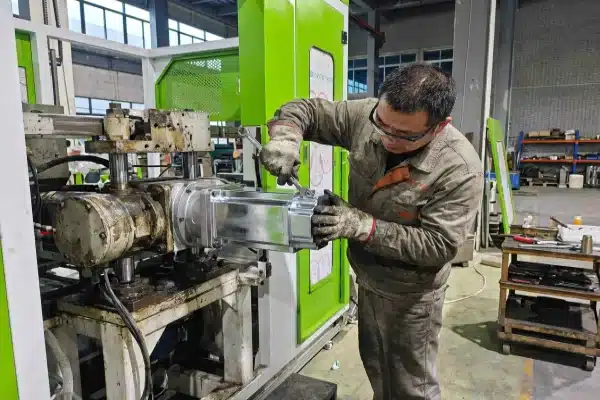
A machine is only as good as its support network. We have seen competitors release a new model and immediately stop supporting the old one, leaving customers stranded. When purchasing, you must move beyond verbal promises and get written commitments regarding the machine's lifecycle.
The PCR Transition and Extrusion Upgrades
The plastics industry is changing rapidly due to environmental regulations. You will likely need to run Post-Consumer Recycled (PCR) material 6 or biodegradable resins within the next decade. These materials behave differently than virgin HDPE. They are often inconsistent and sensitive to heat.
- Mixing Sections: Can the screw be swapped for one with specialized mixing sections?
- Thermal Zoning: Does the barrel support dynamic thermal zoning to control narrow processing windows?
- Co-Extrusion: Can you retrofit a multi-layer die head (e.g., 3-layer) to bury recycled material between layers of virgin plastic?
Your supplier must confirm that the extrusion architecture is adaptable. If the gearbox and barrel mountings are fixed and proprietary, you cannot upgrade to a "SmartHeat" system or a barrier screw later.
Contractual Service Level Agreements (SLAs)
We recommend including an "obsolescence protection" clause in your contract. This should specify that if a critical electronic component (like a servo drive) is discontinued, the supplier is obligated to provide an engineered retrofit solution—not just a "sorry" note. This upgrade pathway should cover:
- Control Systems: Upgrading old HMIs to modern touch panels.
- Safety Logic: Updating guarding to meet future OSHA/CE standards.
- Eficiencia Energética: Retrofitting pulse cooling systems to reduce water usage.
By securing these guarantees, you transform your purchase from a static expense into a dynamic, long-term asset.
Conclusión
Don't just buy a machine; invest in an adaptable platform. Negotiating for PLC scalability, cabinet space, and guaranteed retrofits ensures your production line remains profitable for decades.
Notas al pie
1. Defines all-electric blow molding machines and their operational benefits. ↩︎
2. Official source defining the OPC Unified Architecture standard. ↩︎
3. Defines Service Level Agreements and their importance in contracts. ↩︎
4. Provides a foundational overview of Programmable Logic Controllers. ↩︎
5. Provides a comprehensive definition and explanation of IIoT. ↩︎
6. Explains the definition and significance of Post-Consumer Recycled content. ↩︎


0 Comentarios