
When communicating with Chinese engineers, how should I overcome the language barrier regarding technical terminology for the all-electric extrusion blow molding machine?
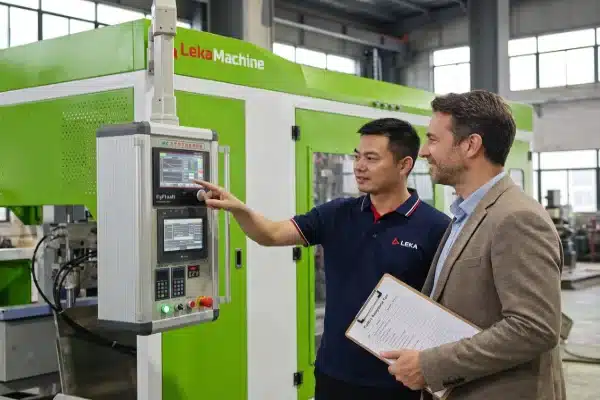
At our Guangdong facility, we see how linguistic misunderstandings derail complex projects Model-Based Definition (MBD) 1. Purchasing advanced all-electric machinery without clear technical communication often leads to costly specification errors, production delays, and wasted investment.
To overcome language barriers, use Model-Based Definition (MBD) with 3D STEP files to bypass text. Create a specific bilingual glossary for servo parameters. Use visual collaboration tools like VooV Meeting for real-time screen sharing, and ensure manuals adhere to ISO 17100 translation standards.
Let’s explore specific methods to bridge this gap and ensure you get exactly what you ordered ISO 17100 translation standards 2.
Can I provide 3D drawings to ensure we are discussing the exact same technical specifications?
When our engineering team customizes blow molders, text descriptions frequently fail STEP AP242 files 3. Relying solely on emails for complex servo-driven clamping specifications creates dangerous ambiguity and potential manufacturing defects that are expensive to fix.
Yes, providing 3D drawings is the most effective way to align specifications. We recommend using STEP AP242 files which support color-coded semantics and Geometric Dimensioning and Tolerancing (GD&T). This allows the geometry itself to communicate tolerances and surface finishes, bypassing the need for translation.
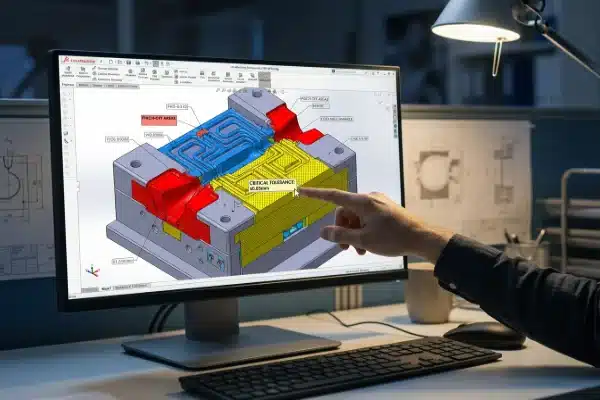
Visual Esperanto: The Power of 3D Model-Based Definition
In the world of precision manufacturing, geometry is the only universal language Controlled Vocabulary 4. When we receive a text-based request stating, "ensure the platen surface is very smooth," it is open to interpretation. Does "smooth" mean a mirror finish or just machined flat? However, a 3D model with specific annotations leaves no room for doubt.
To ensure we are discussing the exact same machine, you must move away from 2D drawings and proprietary CAD formats. We strongly advise against using STL files, which are mesh-based and lose the precision required for CNC machining. Instead, the industry standard for data exchange is the STEP (Standard for the Exchange of Product model data) format.
Why STEP AP242 Matters
Not all STEP files are created equal. The basic AP203 format carries the shape, but the AP242 protocol allows for "Semantic PMI" (Product Manufacturing Information). This means you can color-code surfaces in the 3D model to denote specific manufacturing requirements without writing a single word of English or Chinese.
For example, you can establish a protocol where:
- Red Surfaces: Denote critical shut-off areas (Pinch-offs).
- Blue Surfaces: Denote water cooling channels.
- Yellow Surfaces: Denote areas requiring specific texture (e.g., VDI 3400).
File Format Compatibility Table
Choosing the right file format is the first step in eliminating communication errors. The table below outlines which formats work best for our production team.
| File Format | Suitability | Why use it (or avoid it)? |
|---|---|---|
| STEP AP242 (.stp) | Best | Supports colors, layers, and GD&T annotations. Universal compatibility. |
| Native CAD (.sldprt) | Bien | Works if both sides use the same software version (e.g., SolidWorks 2023). |
| IGES (.igs) | Okay | Good for surfaces but often results in "open gaps" in solid models. |
| STL (.stl) | Avoid | Mesh only. No precise dimensions. Used for 3D printing, not machining. |
| PDF (2D) | Supplement | Use only for legal contracts and title blocks, not for complex geometry. |
By utilizing Geometric Dimensioning and Tolerancing (GD&T) 5 symbols (like $\perp$ for Perpendicularity or $\odot$ for Concentricity) directly on the model, you eliminate adjectives and adverbs that are prone to mistranslation.
Is there a bilingual technical glossary available to clarify specific machine parts?
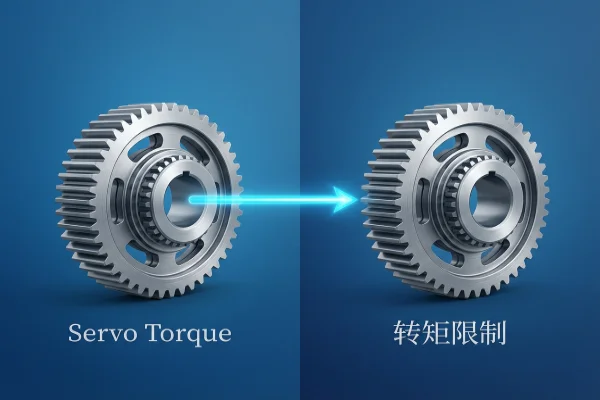
During our export projects, critical confusion often arises over specific electric terminology. Terms like "servo torque" versus "hydraulic pressure" frequently confuse international clients used to older machines, leading to operational errors.
A standardized bilingual glossary is essential for all-electric machinery. You should request a "Controlled Vocabulary" list that defines core components, motion parameters, and defect characterizations in both English and Simplified Chinese. This document serves as the single source of truth for the entire project.
Navigating the "Hydraulic to Electric" Shift
The transition from hydraulic to all-electric machinery changes the entire vocabulary of the shop floor. In a hydraulic machine, you discuss "valves," "pumps," and "flow rates." In an all-electric LEKA machine, the conversation shifts to "encoders," "torque limits," and "ramp rates."
A common issue we encounter is "Chinglish"—literal translations that make no sense. For example, the Chinese term for "Flash" (excess material) is often translated literally as "Flying Edge." While amusing, these small errors can become dangerous when dealing with electrical safety or servo tuning.
To prevent this, we encourage clients to adopt a verified glossary. This is not just a dictionary; it is a functional tool for your operators and maintenance staff.
Essential Bilingual Terms for Electric EBM
We have compiled a list of the most critical terms that differ between languages and machine types. You can copy this table and use it to verify the Human-Machine Interface (HMI) labels on your machine.
| English Term | Chinese (Simplified) | Pinyin | Context / Function |
|---|---|---|---|
| All-Electric | 全电动 | Quán diàn dòng | Distinguishes from Hydraulic (液压). |
| Clamping Unit | 锁模单元 | Suǒ mó dān yuán | The mechanism holding the mold. |
| Servo Motor | 伺服电机 | Sì fú diàn jī | The primary driver. distinct from standard motors. |
| Parison Profile | 型坯壁厚控制 | Xíng pī bì hòu | The 100-point curve controlling bottle thickness. |
| Torque Limit | 转矩限制 | Zhuǎn jǔ xiàn zhì | Safety setting to prevent mold crushing. |
| Zero Return | 原点复归 | Yuán diǎn fù guī | Mandatory homing sequence for servo accuracy. |
| Flash | 飞边 | Fēi biān | Excess plastic waste (often mistranslated as Flying Edge). |
Troubleshooting Defect Terminology
When a machine produces a bad bottle, you need to describe the defect accurately. If you say the bottle is "rough," a Chinese engineer might check the mold polish. But if you use the specific term "Sharkskin" (鲨鱼皮), they immediately know it is a melt fracture issue related to temperature or extrusion speed. Precision in language leads to precision in solutions.
Will the English manual be professionally translated or just machine-generated?
We know that navigating a poorly translated manual is frustrating and risky. Many competitors rely on basic software, resulting in confusing safety instructions that endanger your operators and complicate routine maintenance.
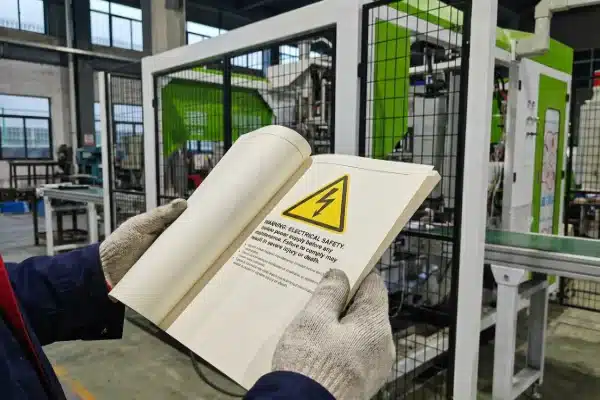
Most standard manuals from China are machine-translated, but you must demand ISO 17100 standard professional translation for safety and maintenance sections. While AI translation is acceptable for general descriptions, critical electrical schematics and HMI logic require human verification to prevent catastrophic operational errors.
The Risks of "Google Translate" in Heavy Machinery
Neural Machine Translation (NMT) 6 has improved, but it lacks context. In Chinese, the character "阀" (Fá) means "Valve." However, in an all-electric context, a manual might be referring to a logic gate in the PLC or a safety gate. If the software translates "Check the Gate" as "Check the Valve" on a machine that has no valves, your maintenance technician will be lost.
Furthermore, Chinese technical writing often omits the subject of a sentence. A phrase like "Turn off power" might be translated as "Close power." In English, "Close" usually applies to a circuit (turning it ON), whereas the intent was to shut it down. These ambiguities are unacceptable for safety protocols.
Implementing a Risk-Based Translation Strategy
Translating a 500-page manual by human experts is expensive. To balance cost and safety, we recommend a hybrid approach. You should categorize the documentation based on risk and apply different translation standards to each.
Translation Standards Protocol
| Document Section | Risk Level | Translation Strategy | Justification |
|---|---|---|---|
| Safety Warnings | Crítica | Human Expert (ISO 17100) | Errors here cause injury or death. Zero tolerance. |
| Esquemas eléctricos | Alta | Human Review | Symbols are universal, but legends need exact terms. |
| HMI Interface | Alta | Human Review | Space constraints often lead to confusing abbreviations. |
| Maintenance Log | Medio | AI + Human Edit (MTPE) | Repetitive content is suitable for AI with a check. |
| General Description | Bajo | Machine Translation | Marketing text does not impact machine function. |
By prioritizing the Safety Manual and the Electrical Diagrams, you ensure that the most dangerous aspects of the machine are clearly understood, while saving costs on less critical sections.
Can we use video calls with screen sharing to walk through the HMI functions together?
When we troubleshoot remotely, email exchanges are often too slow to prevent downtime. We need direct visual access to the control panel to adjust servo parameters immediately and verify the machine’s physical response.
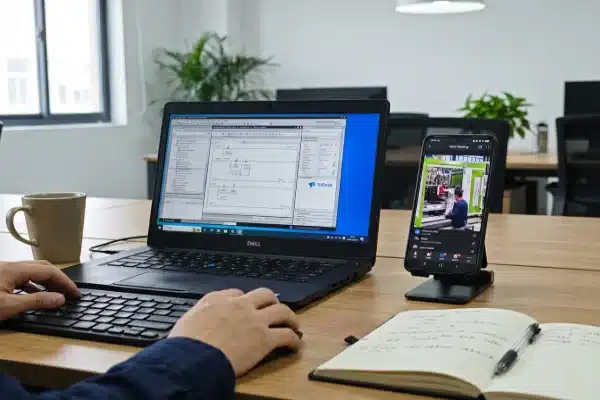
Yes, video calls are vital, but you must use China-accessible tools like VooV Meeting or ToDesk. These platforms bypass firewalls that block Zoom or Teams, ensuring low-latency screen sharing. This allows engineers to visualize HMI parameters and physical machine movements in real-time.
Overcoming the "Great Firewall" Latency
Many Western clients assume that Zoom or Microsoft Teams will work universally. While these tools sometimes connect in China, the connection is often throttled, leading to high latency, frozen screens, and dropped audio. When you are trying to watch a high-speed mold closing sequence, a frozen video feed is useless.
We utilize tools that have servers optimized for mainland China. VooV Meeting (the international version of Tencent Meeting) is the gold standard. It is free, easy to install, and provides crisp, real-time video transmission.
The "Dual-Device" Troubleshooting Setup
Screen sharing alone is not enough. You need to see the HMI screen como the machine moving simultaneously. We recommend a "Dual-Device" protocol for all remote commissioning sessions:
- Device A (PC/Laptop): Runs ToDesk (a remote desktop tool similar to TeamViewer but more stable in China). This allows your engineer to control the mouse on the machine’s computer, checking PLC code or adjusting servo gains directly.
- Device B (Smartphone): Runs VooV Meeting. The operator holds this phone (ideally on a gimbal stabilizer) to film the machine’s physical movements.
Comparison of Remote Collaboration Tools
| Característica | Zoom / Teams | VooV Meeting 7 | ToDesk |
|---|---|---|---|
| Connection Stability | Low (Blocked/Throttled) | Alta (Native) | Alta (Native) |
| Video Latency | High (>300ms) | Low (<100ms) | Low (<100ms) |
| Screen Sharing | Yes (Often blurry) | Yes (High FPS) | Sí |
| Remote Control | No | No | Yes (Mouse/Keyboard) |
| VPN Required? | Yes (for China side) | No | No |
Using this setup, you can change a parameter on the screen and immediately see the physical result on the video feed, effectively replicating the experience of being on the factory floor.
Conclusión
Clear communication bridges the gap between Western standards and Chinese manufacturing. By leveraging 3D MBD tools, specific bilingual glossaries, and China-optimized digital infrastructure, you ensure project success and operational safety while eliminating ambiguity.
Notas al pie
- Replaced with an authoritative publication from NIST on Model-Based Definition. ↩︎
- Official ISO page detailing the requirements for translation services. ↩︎
- Official ISO standard for the managed model-based 3D engineering. ↩︎
- NISO provides standards and best practices for controlled vocabularies. ↩︎
- ASME is a leading developer of GD&T standards and resources. ↩︎
- Wikipedia offers a comprehensive overview of Neural Machine Translation. ↩︎
- Official website for VooV Meeting, a China-accessible video conferencing tool. ↩︎


0 Comentarios