Costo de la máquina de moldeo por soplado: El Costo Total de Propiedad real frente al precio

Tiempo de lectura: ( Word Count: )

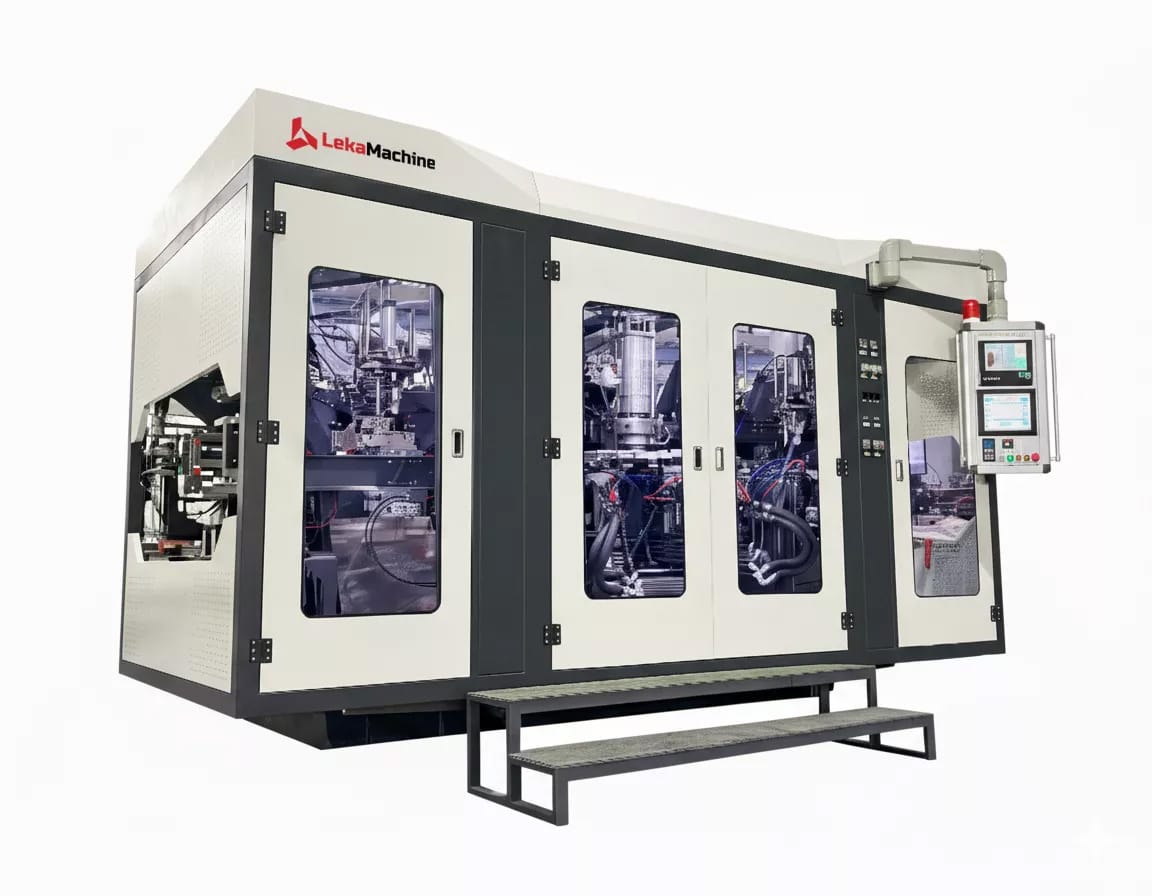
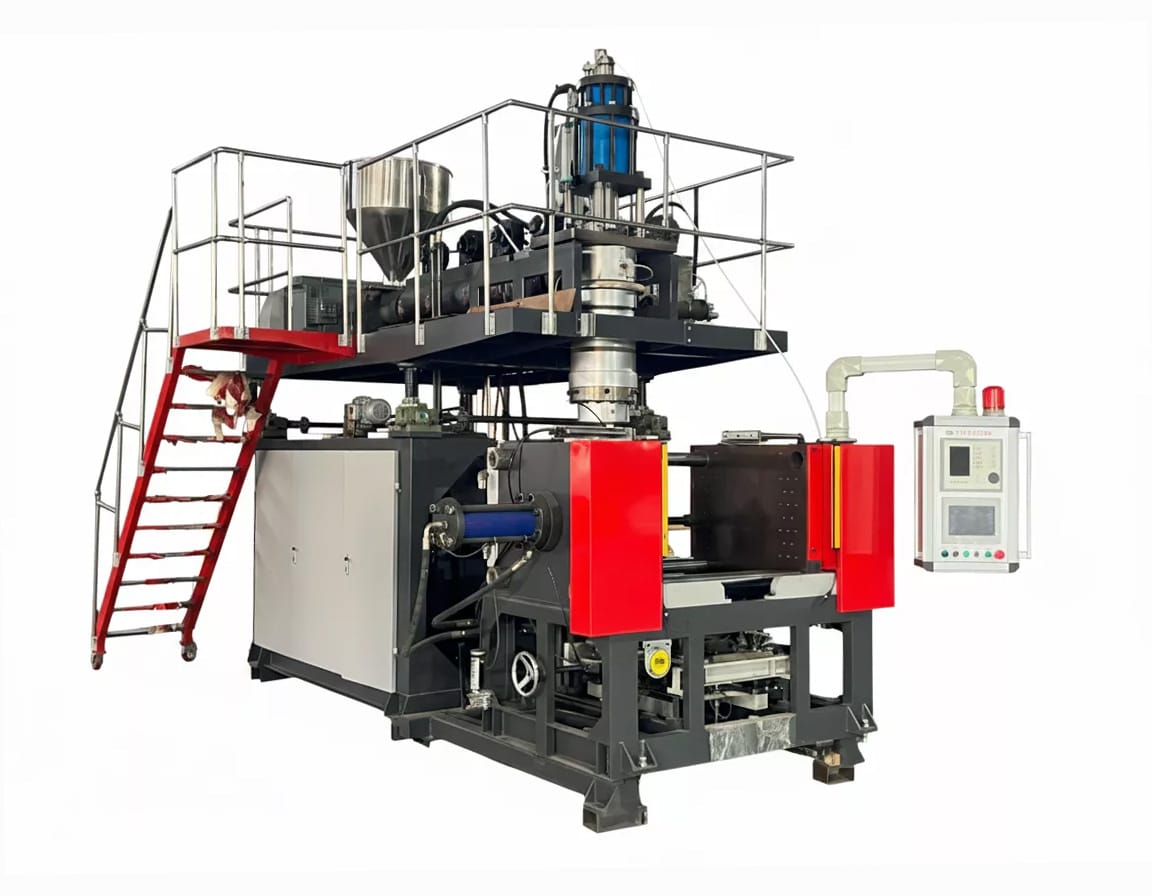
Trade show booth with enclosed blow molding machine and sample plastic jugs on display

octubre 24, 2025

How to Calculate the Real Cost of a Blow Molding Machine (Free TCO Checklist Download): Why a “Cheap” Machine Can Be Your Most Expensive: Why a “Cheap”

When you’re ready to buy a new blow molding machine, you want to get the best value, not just the lowest price.

But I’ve seen too many factories buy a “cheap” machine, only to pay for it over and over again in the following years.

The purchase price is just the beginning. The real number you need to care about is the “Total Cost of Ownership,” or TCO.

Let’s talk about the real cost curve of a low-energy machine versus a high-energy one. (We’ll also give you a checklist to download so you can calculate your own.)

Section 1: The High-Energy Trap (High Power! High Air!) – The “Cheap” Machine’s Cost Curve

A lot of people only look at the purchase price. Let’s run the numbers.

Imagine you have two machines to choose from:

  • Machine A (Low-Price, High-Energy): Purchase Price $100,000
  • Machine B (High-Efficiency, Stable): Purchase Price $180,000

Looking only at the price, Machine A seems to save you $80,000. But let’s factor in energy costs (with seasonal spikes), maintenance, labor, and scrap rates (with real-world problems). See what happens after 5 years.

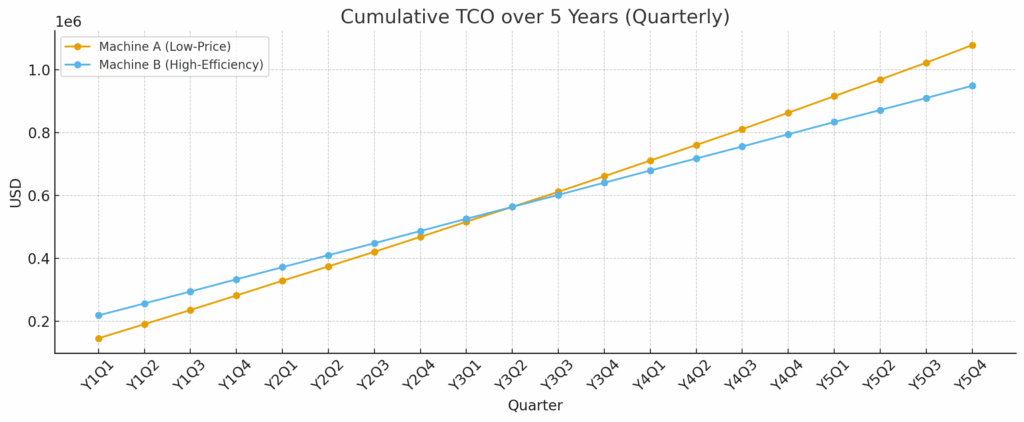
Look at this 5-Year TCO (Total Cost of Ownership) Comparison (with real-world spikes):

What this shows: These are the two cost curves. You can see how the “cheap” orange line (Machine A) crosses over the efficient blue line (Machine B) right around Year 3. After that, the cost gap explodes.

Low-Price Mahine (Machine A)High-Efficiency Machine (Machine B)
QuarterEnergy Cost ($)Maint. Cost ($)Scrap Cost ($)Labor Cost ($)Downtime (Hrs)Output (M Bottles)Cumulative TCO ($)Energy Cost ($)Maint. Cost ($)Scrap Cost ($)Labor Cost ($)Downtime (Hrs)Output (M Bottles)Cumulative TCO ($)
Y1Q112,375.002,000.001,424.3030,00020.001.48145,799.307,425.00550.00737.0130,0005.001.79218,712.01
Y1Q211,250.002,200.001,580.8730,00022.001.48190,830.166,750.00561.00721.8030,0005.101.79256,744.81
Y1Q311,250.002,420.001,323.5130,00024.201.48235,823.676,750.00572.22702.6930,0005.201.79294,769.72
Y1Q412,375.002,662.001,278.0530,00026.621.47282,138.717,425.00583.66733.2230,0005.311.79333,511.60
Y2Q112,375.002,928.201,515.3330,00029.281.47328,957.257,425.00595.34726.3630,0005.411.79372,258.30
Y2Q211,250.003,221.021,256.6930,00032.211.47374,684.956,750.00607.24737.5830,0005.521.79410,353.12
Y2Q311,250.003,543.121,610.6330,00035.431.46421,088.716,750.00619.39704.9230,0005.631.79448,427.42
Y2Q412,375.003,897.431,321.5730,00038.971.46468,682.717,425.00631.78703.6230,0005.741.79487,187.82
Y3Q112,375.004,287.181,371.5530,00042.871.46516,716.447,425.00644.41718.2530,0005.861.79525,975.48
Y3Q211,250.004,715.901,423.1830,00047.161.45564,105.526,750.00657.30708.1530,0005.981.79564,090.93
Y3Q311,250.005,187.481,496.7230,00051.871.45612,039.726,750.00670.45701.5630,0006.091.79602,212.94
Y3Q412,375.005,706.231,352.9630,00057.061.44661,473.917,425.00683.86711.2730,0006.221.79641,033.07
Y4Q112,375.006,276.861,418.2930,00062.771.44711,544.067,425.00697.53729.2230,0006.341.79679,884.82
Y4Q211,250.006,904.541,302.0330,00069.051.43761,000.636,750.00711.48717.5130,0006.471.79718,063.81
Y4Q311,250.007,595.001,463.5330,00075.951.42811,309.166,750.00725.71697.3330,0006.601.79756,236.85
Y4Q412,375.008,354.501,462.1530,00083.541.42863,500.817,425.00740.23702.6030,0006.731.79795,104.68
Y5Q112,375.009,189.951,224.3730,00091.901.41916,290.127,425.00755.03736.0130,0006.861.79834,020.72
Y5Q211,250.0010,108.941,594.3230,000101.091.40969,243.396,750.00770.13729.9030,0007.001.79872,270.76
Y5Q311,250.0011,119.831,307.4030,000111.201.391,022,920.626,750.00785.54699.2730,0007.141.79910,505.57
Y5Q412,375.0012,231.821,453.8330,000122.321.381,078,981.267,425.00801.25713.9330,0007.281.79949,445.74

Let’s analyze these data one by one:

1. The Big Picture: TCO, Crossover, and Savings

Gráfico lineal del CTM acumulado a cinco años que muestra que la Máquina A aumenta ligeramente más rápido que la Máquina B cada trimestre

These are the two cost curves. You can see how the “cheap” orange line (Machine A) crosses over the efficient blue line (Machine B) right around Year 3. After that, the cost gap explodes.


Gráfico lineal que muestra la brecha trimestral del CTM, donde los valores positivos indican que la Máquina A es más costosa que la Máquina B

This chart zooms in on the crossover. At Y3Q2 (Year 3, Quarter 2), the orange line breaks through zero. This is the exact moment your initial $80,000 in “savings” has been completely erased by high operating costs. From this day forward, you are losing money.

Gráfico de barras del ahorro a cinco años de la Máquina B frente a la A en energía, mantenimiento, desperdicio y mano de obra

This is the inverse of the TCO gap. It shows how the savings from buying the efficient Machine B (blue line) are negative at first (because of the higher price) but become massively positive over time, ending at $129,536.

2. Why Does This Happen? Production & Downtime

Right after the heading “2. Why Does This Happen? Production & Downtime”, insert

Gráfico lineal de horas de inactividad por trimestre que muestra la Máquina A aumentando de aproximadamente 20 a 121, mientras la Máquina B se mantiene cerca de 6-7

What this shows: Here is the causa of the high costs. The “cheap” machine’s downtime (orange line) spirals upward, becoming uncontrollable by Year 5. The efficient machine (blue line) stays stable and low.

After the text above, insert:

Gráfico lineal de producción trimestral que muestra la Máquina B estable en 1.8 millones de botellas, mientras la Máquina A desciende de aproximadamente 1.47 a 1.38

What this shows: This is the result of downtime. The “cheap” machine’s output (orange line) constantly drops as it breaks down more. Machine B (blue line) reliably produces 1.79 million bottles every quarter.

After the text above, insert:

Gráfico lineal de producción acumulada a cinco años que muestra la Máquina B consistentemente por encima de la Máquina A cada trimestre

What this shows: Over 5 years, the stable Machine B (blue bar) produced 35.8 million bottles, while the unreliable Machine A (orange bar) produced only 29.3 million. That’s 6.5 million fewer bottles.

Where Did the Money Go? A Look at Costs

Gráfico de barras que compara el CTM anual agregado de la Máquina A frente a la Máquina B durante cinco años

What this shows: This chart clearly shows when the costs accelerated. Look at the orange bars (Machine A): the total cost added in Year 5 alone was far greater than in Year 1. Machine B’s costs (blue bars) remained predictable.

Gráfico de barras agrupadas de componentes de costos operativos a cinco años para dos máquinas, mostrando el mayor gasto en mano de obra, con mayor energía, mantenimiento y desperdicio para la Máquina A

What this shows: This is the smoking gun. It shows what you paid for. The “cheap” Machine A (orange bar) forced you to pay enormous “Energy” and “Maintenance” costs, completely wiping out any initial savings.

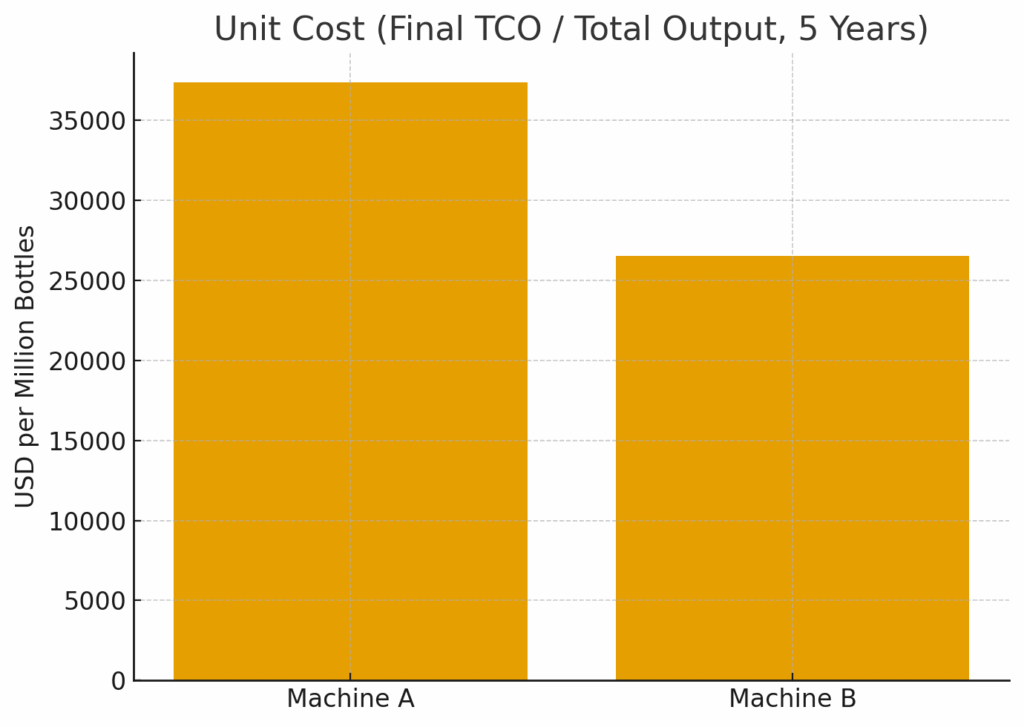
4. The Final Verdict: Cost Per Unit

Gráfico de barras que compara el costo unitario de la Máquina A y la Máquina B en USD por millón de botellas durante cinco años

What this shows: This might be the most important chart. When you divide the total 5-year cost by the actual bottles produced, the truth is clear:

  • Machine A (Low-Price): Your cost to produce 1 million bottles was $36,800.
  • Machine B (High-Efficiency): Your cost to produce 1 million bottles was only $26,400.The conclusion is clear:You thought you saved $80,000 up front. In reality, every single bottle you made with the “cheap” machine cost you almost 40% more to produce.

    (Note: This doesn’t even count the air compressor…)


The “efficient” Machine B only cost $949,445 in total.

You ended up **paying $129,536 extra**.

(*Note: This doesn’t even count the air compressor. Bottle blowing uses a lot of air, and the compressor for an inefficient machine will also use a shocking amount of power.*)

In short: a cheap machine has a low return on efficiency because the money you “saved” up front is paid back twice over in future power and repair bills.

Section 2: The Efficiency Payoff (The High-Efficiency Machine’s Cost Curve)

A high-efficiency machine costs more up front. There’s no way around it.

This is because it’s built with better parts and better engineering.

But its cost curve is completely different. It starts higher, but it stays flat.

Month after month, your energy costs are far lower than your competitors.

Your maintenance is predictable, not a daily fire drill.

This is the machine that lets you confidently tell your clients “yes” when they need a fast delivery.

(To be frank, our most competitive OEM customers are the ones who focus on TCO.)

Section 3: What *Actually* Makes a Machine Efficient?

A machine isn’t efficient just because a salesperson says so.

You can’t just look at the price. You have to dig deeper into three key areas. This is what decides if a machine will save you money or cost you money:

1. The Configuration

This is the “heart” of the machine.

What kind of hydraulic system does it use? Is it an old-fashioned fixed pump, or a modern servo-motor system? (For example, many of our machines use servo-driven pumps to precisely control energy use).

Are the parts from no-name brands or well-known brands? A good configuration uses parts that are all designed to work together to save power, not just a random mix.

2. The Assembly Precision

This is extremely important. A machine that is assembled with high precision has parts that move smoothly.

Less friction means less wasted energy. It’s that simple.

If a machine is assembled badly, even with good parts, the parts will “fight” each other. This extra friction forces the motors to work harder, which pulls more power. It also means parts wear out much faster.

I want to share a “little story” about this:

We’ve tried many ways to process our parts, including expensive CNC machining. But we found two things: first, it raises the machine cost a lot. Second, for some key details, the “feel” of an experienced technician is something a cold machine just can’t replace.

So, our team is built on veteran technicians with years of hands-on experience. At the same time, we partner with outside institutes and even universities in China to research and train our team.

This teamwork helps us optimize some of our machine structures and assembly processes. It lets us make the machine’s assembly more accurate, snug, and “silky smooth” to operate, without dramatically raising the cost.

3. The Lubrication Design

This is related to assembly precision. A well-built machine with a smart lubrication system runs smoothly and doesn’t get too hot.

A poorly designed machine won’t get oil where it’s needed. Parts will grind and heat up. The machine wastes a ton of energy just fighting its own internal friction, before it even starts making a product.

For example: At LEKAmachine, we’ve put a lot of innovation into our hydraulic circuit and mechanical designs. Our goal is to make every push of the hydraulic system as efficient as possible. We want to use that energy to *actually* clamp the mold and extrude plastic, not waste it inside the pipes.

Section 4: Our View on Long-Term Value

At LEKAmachine, we design our machines for reliability and efficiency first.

We know our customers (you) care about output per hour and cost per hour.

We focus on providing Moldeo por Soplado por Extrusión (EBM) como Moldeo por Soplado Estirado (SBM) machines. We don’t sell injection blow molding machines, because we only focus on what we do best.

Conclusion: Look at the 5-Year Cost, Not the Day-1 Price

A blow molding machine is a 10-year investment. Don’t let a Day-1 low price trap you into 10 years of high power bills and repair headaches.

When you’re ready to upgrade your production line, I suggest you ask about the “total cost.”

You need a machine that solves your production bottlenecks, not a machine that becomes one.

Call to Action:

[Click Here to Download: Blow Molding Machine TCO (Total Cost of Ownership) Checklist.pdf] <– (You can put your download link here)

Si está cansado de las facturas energéticas elevadas y los constantes tiempos de inactividad, consulte nuestras soluciones.

  • Explore nuestras Máquinas de moldeo por extrusión-soplado: `https://lekamachine.comextrusion-blow-molding-machines/`
  • Explore nuestras Máquinas de Moldeo por Soplado Estirado (Estirado-Soplado): `https://lekamachine.comstretch-blow-molding-machine/`


Desbloquee ahora el proceso de adquisición profesional de máquinas de moldeo por soplado

    Slany Cheung

    Slany Cheung

    Autor

    Hola, soy Slany Cheung, Directora de Ventas de Lekamachine. Con 12 años de experiencia en el sector de la maquinaria de moldeo por soplado, conozco a fondo los retos y las oportunidades a los que se enfrentan las empresas a la hora de optimizar la producción y mejorar la eficiencia. En Lekamachine, estamos especializados en ofrecer soluciones de moldeo por soplado integradas y totalmente automatizadas, al servicio de industrias que van desde la cosmética y la farmacéutica hasta los grandes contenedores industriales.

    A través de esta plataforma, pretendo compartir información valiosa sobre las tecnologías de moldeo por soplado, las tendencias del mercado y las mejores prácticas. Mi objetivo es ayudar a las empresas a tomar decisiones informadas, mejorar sus procesos de fabricación y seguir siendo competitivas en un sector en constante evolución. Acompáñeme mientras exploramos las últimas innovaciones y estrategias que están dando forma al futuro del moldeo por soplado.

    También te puede gustar...

    0 Comentarios

    Enviar un comentario

    Tu dirección de correo electrónico no será publicada. Los campos obligatorios están marcados con *