

How should I assess whether the hardness of the mold mounting plate on the ALL electric extrusion blow molding machine is sufficient?
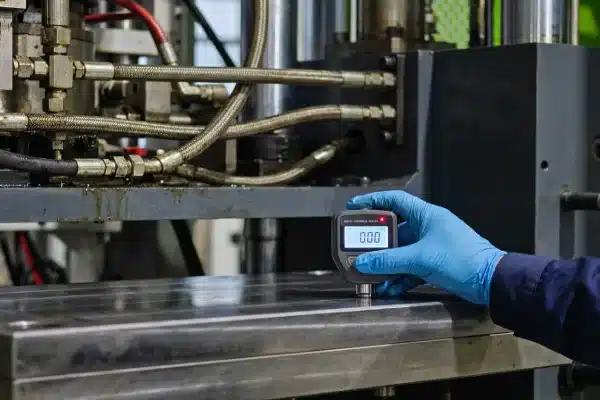
At our facility in Shantou, we often see clients focus entirely on the extruder output while ignoring the machine’s skeleton—the platen P20 or 4140 1. If your mounting plate is too soft, it will eventually warp under the constant toggling force. This leads to flash, poor parting lines, and expensive downtime Rockwell C (HRC) or Brinell testing 2.
To assess platen hardness, request material certificates confirming pre-hardened steel grades like P20 or 4140. Verify these specifications against independent Rockwell C (HRC) or Brinell testing during the Factory Acceptance Test (FAT) to ensure a minimum range of 28–34 HRC for long-term durability.
You must dig deeper than just trusting the datasheet Factory Acceptance Test (FAT) 3. A reliable assessment involves physical verification and understanding the relationship between clamping force and steel grade.
What is the Rockwell hardness rating of the platen steel to ensure it withstands high clamping pressure?
When we engineering our all-electric EBM machines, we calculate the massive kinetic energy generated by servo motors nitriding 4. If the steel is too soft, the mold will literally leave an impression on the platen over time. Weak steel cannot support the precision that electric drives offer electroless nickel plating 5.
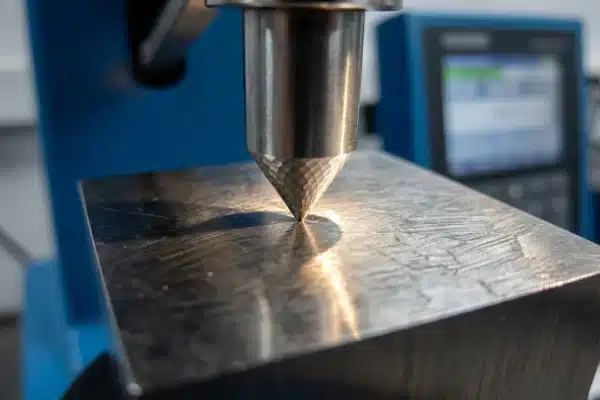
The ideal platen steel for all-electric EBM machines typically features a Rockwell hardness rating of 28–34 HRC (approximately 280–330 HB). This range provides the necessary rigidity to withstand high tonnage without indentation while maintaining enough ductility to prevent brittle cracking under cyclic stress.
Understanding Steel Grades and Hardness
In the blow molding industry, the “heart” is the extruder, but the “bones” are the platens. Using the wrong steel is like building a skyscraper on a foundation of sand. We recommend asking your supplier for pre-hardened steel grades, specifically P20 (AISI) or 4140 chrome-moly steel.
These materials are industry standards for a reason. They offer a balance. If the steel is too hard (above 50 HRC core hardness), it becomes brittle. Under the shock of rapid opening and closing cycles—especially in high-speed electric machines—brittle steel can crack. Conversely, standard mild steel (like A36 or 1045) is too soft. It will suffer from “coining,” where the mold base digs into the platen, destroying parallelism.
Why All-Electric Machines Demand Higher Quality
All-electric machines deliver instant torque. Unlike hydraulic systems that ramp up pressure, servo motors provide immediate clamping force. This puts higher stress on the platen structure.
- P20 Steel: excellent polishability and uniform hardness.
- 4140 Steel: High fatigue strength and abrasion resistance.
Below is a comparison of common platen materials we encounter in the market:
Table 1: Common Platen Steel Grades and Suitability
| Steel Grade | Typical Hardness (HRC) | Suitability for EBM | Risk Factor |
|---|---|---|---|
| Mild Steel (1045) | 10–15 HRC | Low | High risk of deformation and indentation. |
| P20 / 4140 (Pre-hard) | 28–34 HRC | High (Recommended) | Balanced toughness and wear resistance. |
| H13 (Through-hard) | 48–52 HRC | Medium | Too brittle for large structural platens; risk of cracking. |
When you audit a supplier, ask for the “Hardness Test Certificate” for the specific block of steel used on your machine. Do not accept a generic brochure.
Have the mounting holes been hardened to prevent thread damage during frequent mold changes?
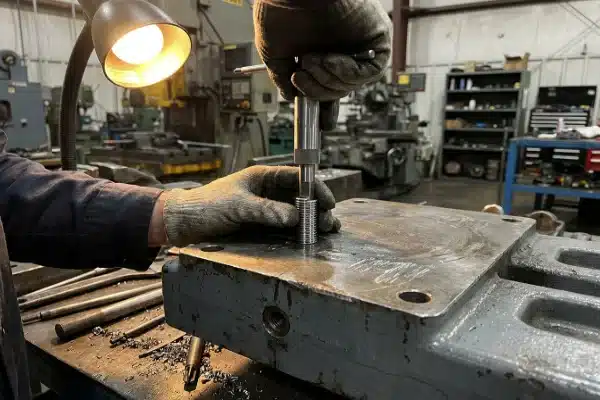
In our experience helping customers set up their lines, thread damage is the number one cause of frustration during mold changeovers. If your team changes molds weekly to switch between bottle sizes, soft threads will strip quickly. A stripped hole means the mold is not secure, which is a major safety risk.
Mounting holes should utilize hardened inserts or undergo nitriding to achieve a surface hardness of 48–52 HRC. This specific localized hardening prevents thread stripping and galling caused by frequent bolt tightening during mold changeovers, significantly extending the service life of the platen.
The Mechanics of Thread Failure
The core of the platen needs to be tough (28–34 HRC), but the threads need to be much harder. If the threads are the same hardness as the bolts, or softer, they will “gall.” Galling 6 occurs when friction causes the metals to adhere to each other, tearing out the threads when you remove the bolt.
For our LEKA machines, we emphasize the use of distinct strategies to protect these critical interface points.
H3 – Localized Hardening Strategies
There are two main ways to solve this:
- Nitriding: This is a heat treatment process that diffuses nitrogen into the surface of the steel. It creates a very hard “skin” (case hardening) while keeping the core strong. This is excellent for corrosion resistance and wear.
- Hardened Inserts (Helicoils or Key-locking inserts): This is often the superior choice for aluminum or softer steel platens. We drill the hole larger and screw in a pre-hardened stainless steel insert. If an operator cross-threads a bolt, you simply replace the insert, not the whole platen.
Comparison of Thread Protection
The cost of repairing a stripped platen thread involves downtime, drilling, tapping, and potential misalignment. It is far cheaper to specify hardened threads upfront.
Table 2: Thread Hardening Options
| Method | Surface Hardness | Pros | Cons |
|---|---|---|---|
| Standard Tapped Hole | ~30 HRC (Base Metal) | Cheapest | High risk of stripping after 50+ changes. |
| Nitriding Treatment | ~50–60 HRC | Excellent wear resistance | Cannot be repaired easily if damaged. |
| Hardened Steel Inserts | 45–50 HRC | Replaceable, durable | Slightly higher initial manufacturing cost. |
Always check if the T-slots or mounting holes have chamfered edges. Sharp edges on mounting holes are stress concentrators that can lead to cracking.
How do you test the platen for deflection or warping under maximum tonnage?
We always tell our clients: “A flat platen equals a flat bottle.” During our internal testing, we use precision instruments to ensure the platen doesn’t bow like a banana when the clamping unit locks. Even a microscopic bend causes the mold to open slightly at the parting line.
We test for deflection by mounting a dial indicator or laser sensor to the platen center while applying maximum clamping tonnage. The measurement must confirm that physical bending remains within strict parallel tolerances (typically under 0.005 inches per foot) to guarantee uniform mold sealing.
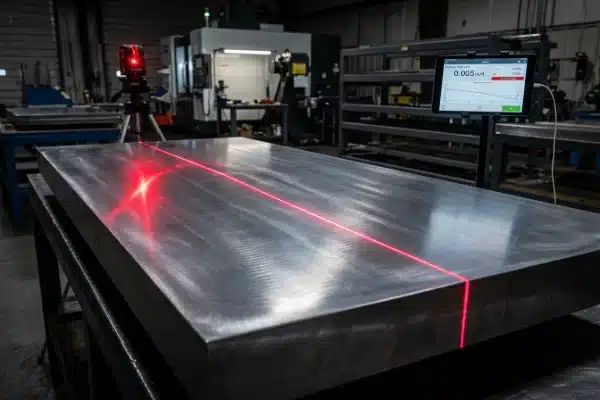
Deflection vs. Parallelism
Many buyers confuse these two terms.
- Parallelism: Do the two platens sit perfectly flat against each other when open?
- Deflection: How much does the metal bend when full force (e.g., 20 tons) is applied?
In extrusion blow molding, deflection is critical because of the “pinch-off.” The mold must cut the plastic parison cleanly at the top and bottom. If the platen deflects, the clamping force concentrates at the edges of the mold, leaving the center loose. This results in heavy flash at the bottle handle or bottom, which ruins the bottle’s aesthetics and wastes material.
H3 – The Measurement Protocol
To verify this, you should demand a deflection test report. Here is how we typically validate this in a high-quality machine build:
- Mount the Sensor: A magnetic base holds a micron-level dial indicator on the stationary platen.
- Touch Off: The probe touches the center of the moving platen (or the mold base).
- Apply Load: The machine cycles to “lock” position at 100% tonnage.
- Read Variance: The gauge shows how much the center moves relative to the edges.
For a standard EBM machine, deflection should not exceed 0.0005 inches per inch of platen span. If it does, the platen design is too thin or the webbing (ribbing) on the back of the casting is insufficient.
Table 3: Consequences of Excessive Platen Deflection
| Deflection Level | Impact on Production | Remedial Action |
|---|---|---|
| < 0.1mm | Negligible. Good pinch-off. | None. |
| 0.1mm – 0.3mm | Thin flash on bottle parting lines. | Increase clamp force (wastes energy). |
| > 0.3mm | Blowouts, weak welds, bottle leaks. | Machine requires structural reinforcement or de-rating. |
Is the platen surface treated to resist corrosion from cooling water or humidity?
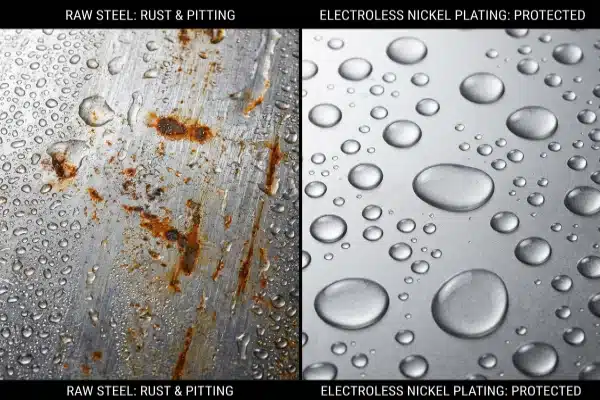
When we export machines to tropical climates like Southeast Asia or humid regions in North America, we see untreated steel rust within weeks. Blow molding uses chilled water (often 10°C) to cool the molds. This creates a “sweating” effect where condensation drips onto the platen.
Yes, platens require surface treatments like electroless nickel plating, black oxide, or chrome coating to resist oxidation. These treatments protect the steel from corrosion caused by inevitable condensation from chilled molds and high ambient humidity, preventing surface pitting that compromises mold alignment.
The “Sweat” Problem in EBM
Unlike injection molding, blow molding molds are often run very cold to reduce cycle times. When you open the mold, the moisture in the air condenses immediately on the cold metal faces. This water eventually migrates to the platen surface.
If your platen is raw P20 steel, it will rust. Rust creates an uneven surface. Over time, this buildup pushes the mold out of alignment. Even a 0.1mm rust scale can cause mold mismatch, leading to “stepped” bottle necks where the cap won’t seal properly.
H3 – Effective Surface Treatments
We evaluate three main types of protection for our clients based on their budget and environment:
- Grease/Oil: The most basic protection. It works for storage but is messy during production and eventually wipes off.
- Black Oxide: A chemical conversion coating. It offers mild corrosion resistance and looks professional (black finish). It is standard on many mid-range machines.
- Electroless Nickel Plating: The gold standard. This deposits a uniform layer of nickel alloy. It is extremely hard, very slippery (good for mold loading), and highly corrosion-resistant.
For food-grade or cleanroom environments (medical bottles), nickel plating is almost mandatory because it does not flake or chip.
Critical Maintenance Tip
Regardless of the coating, we advise our customers to spray a rust inhibitor on the platen face whenever a mold is removed. Do not leave a wet mold mounted on the machine over the weekend. The trapped moisture between the mold backplate and the machine platen will cause galvanic corrosion, pitting the face of your expensive equipment.
Conclusion
Assessing the platen hardness is not just a technical checkbox; it is a financial safeguard. A soft platen leads to poor bottle quality, damaged molds, and reduced machine value. Always verify the steel grade (aim for P20/4140), insist on hardened threads or inserts, check for deflection under load, and ensure proper corrosion protection.
- Check the Steel: 28-34 HRC.
- Check the Threads: Hardened inserts.
- Check the Deflection: <0.005 inches/foot.
If you are unsure about the specifications of your current machinery or need a second opinion on a new quote, feel free to contact us. We can help review your technical requirements to ensure you are buying a machine built to last.
Footnotes
- Explains properties and composition of 4140 steel, relevant to platen material. ↩︎
- Provides the standard test methods for Rockwell hardness of metallic materials. ↩︎
- Clearly defines FAT as a pre-delivery test to ensure a machine meets customer requirements. ↩︎
- Explains nitriding as a heat treatment process for case hardening metal surfaces. ↩︎
- Describes electroless nickel plating as a chemical process for uniform coating and corrosion resistance. ↩︎
- Defines galling as a form of wear caused by adhesion between sliding surfaces. ↩︎




0 Comments