
How should I evaluate the supplier’s response process for emergency breakdowns of the ALL electric extrusion blow molding machine?
At our factory, we know that an idle all-electric machine bleeds money faster than a hydraulic one leaks oil. When a servo drive 1 fails, you need instant answers, not hold music or vague promises.
To evaluate a supplier, audit their remote diagnostic capabilities including VPN access and servo data forensics. Demand a contract with tiered response time SLAs that specify financial penalties for delays. Crucially, verify they stock electronic components regionally to ensure next-flight-out delivery for critical breakdown scenarios.
You cannot afford to wait until the machine stops to discover your supplier’s support team is understaffed or untrained. Here is how we recommend vetting their emergency response protocols.
What remote diagnostic tools are included to speed up troubleshooting?
When we commission machines globally, we rely on digital eyes because physical travel is too slow for modern production demands. All-electric EBMs generate massive amounts of data that must be accessible instantly.
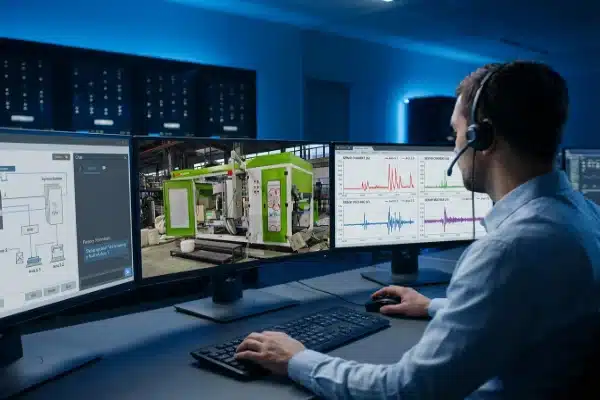
Prioritize suppliers offering secure IIoT-enabled remote access that allows technicians to view live PLC logic and force I/O signals. Look for "Black Box" data logging that captures high-frequency servo current and torque data, enabling engineers to distinguish between mechanical jams and drive faults without visiting your factory.
In the era of all-electric extrusion blow molding (EBM), the "screw and wrench" approach to maintenance is obsolete. The complexity of servo systems requires a software-first approach. When we build our machines, we integrate layers of digital accessibility, and you should demand the same from any potential partner.
The Necessity of VPN and IIoT Gateways
A supplier who asks you to "take a video of the screen" is stuck in the past. Top-tier support requires a secure, encrypted connection (via VPN or proprietary IIoT gateways 2). This allows the supplier’s engineer to virtually "sit" at your machine’s console. They must be able to:
- Read live PLC logic 3 directly from the controller.
- Monitor real-time temperature curves and parison control profiles.
- Force input/output signals to test specific valves or relays.
"Black Box" Servo Forensics
Unlike hydraulic machines, all-electric units provide precise feedback on torque, current, and position. We find that generic alarms like "Overload Error" are insufficient. You need a supplier whose tools can extract high-frequency "flight recorder" buffers. This data helps distinguish whether a shutdown was caused by a physical jam (spike in torque) or a failing drive component (spike in current with no load).
Comparison: Hydraulic vs. Electric Diagnostics
The diagnostic toolkit for an electric machine is fundamentally different. Use this table to quiz your supplier:
| Feature | Hydraulic Machine Support | All-Electric Machine Support |
|---|---|---|
| Primary Tool | Pressure gauges and flow meters | Oscilloscope functions and Data Loggers |
| Common Faults | Oil leaks, valve sticking, heat | Encoder errors, communication loss, firmware bugs |
| Remote Capability | Low (requires physical inspection) | High (90% of issues visible via software) |
| Power Sensitivity | Low | High (requires analysis of voltage sags/harmonics) |
If your supplier cannot explain how they remotely analyze servo load curves, they are likely just assemblers, not true engineering partners.
Do you offer guaranteed response time SLAs in the service contract?
We promise our clients specific production targets, so we expect the same strict accountability from our component partners. A handshake or a verbal "we will do our best" is not enough when your production line stops.
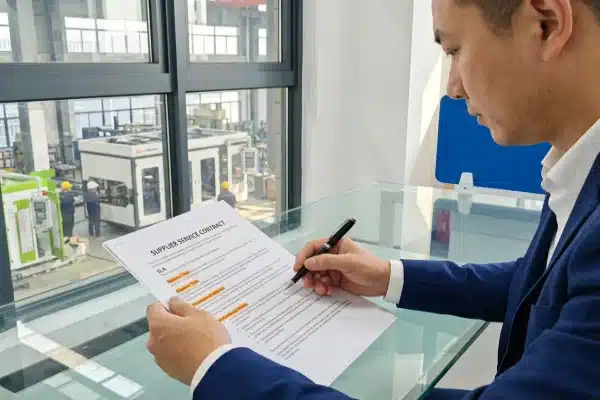
A robust Service Level Agreement (SLA) must separate "initial callback" from "on-site arrival." Ensure the contract guarantees a 1-hour engineer callback and 24-hour on-site dispatch for machine-down events. Verify that the hotline routes directly to Level 2 specialists, avoiding time-wasting general call centers.

A Service Level Agreement (SLA) 4 is your insurance policy. However, many suppliers draft SLAs that are intentionally vague. Through our years of exporting, we have learned to look for specific definitions that protect the buyer’s interests.
Defining Response Tiers
Not all breakdowns are equal. A burnt heater band is annoying; a corrupted PLC is catastrophic. Your contract should reflect this. We recommend negotiating a tiered structure similar to the one below:
| Severity Level | Definition | Response Target (Remote) | Response Target (On-Site) |
|---|---|---|---|
| Level 1 (Critical) | Machine Down. Total production stoppage. | < 1 Hour (24/7) | < 24 Hours |
| Level 2 (High) | Quality compromised or reduced speed. | < 4 Hours | < 48 Hours |
| Level 3 (Normal) | Minor bug, question, or parts inquiry. | Next Business Day | Scheduled Visit |
Competency-Based Routing
One of the biggest frustrations we hear from customers switching to us is the "Call Center Loop." When you call an emergency line, you should not speak to a receptionist who simply takes a message.
- The Requirement: The hotline must connect to a "Level 2" specialized engineer.
- The Reason: All-electric machines are complex. A generalist cannot troubleshoot a motion control synchronization error.
- The Test: Ask for the direct number of their technical lead. If they hesitate, their support structure may be too bureaucratic for emergency needs.
Financial Penalties
An SLA without teeth is just a wish list. Negotiate terms where the supplier credits a portion of your service contract or extends your warranty if they miss their response targets. This aligns their financial incentives with your operational uptime.
How quickly can critical spare parts be shipped to my location?
In our warehouse management, we learned the hard way that a missing $50 sensor can ground a million-dollar line. Reliance on a single central warehouse is a logistical gamble you should not accept.
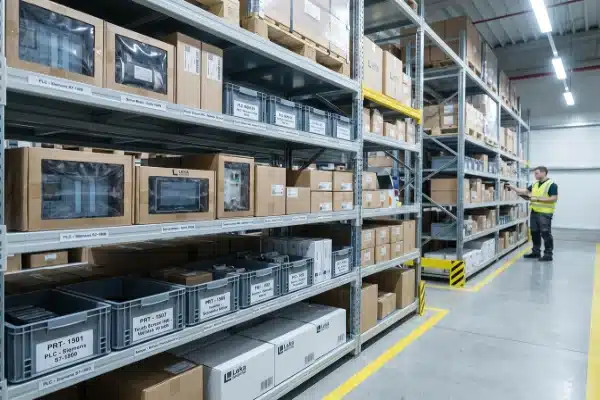
Evaluate whether the supplier maintains regional inventory hubs for critical electronics like servo drives and PLCs, ensuring same-day or next-flight-out delivery. Furthermore, check the contract for clauses guaranteeing the availability of compatible electronic replacements for 10–15 years to protect against component obsolescence.
For all-electric machines, the critical spare parts 5 strategy differs significantly from hydraulic systems. Metal valves and pumps have long lifecycles and generic replacements. Electronic drives and controllers do not.
The "Critical Spares" Geography
Don’t just ask "do you have parts?" Ask "where are the parts?"
If your factory is in Ohio and the supplier’s only warehouse is in Germany or China, you are facing a minimum of 48 to 72 hours of downtime for customs and shipping.
- Regional Hubs: Top suppliers keep expensive items like Servo Drives, Inverters, and Touchscreens in regional logistics hubs 6 (e.g., within the US or EU).
- Consignment Stock: Ask if they are willing to place a "Crash Kit" on your shelf, where you only pay for the part when you break the seal.
Managing Electronic Obsolescence
Electronic components evolve rapidly. A servo drive made today might be discontinued in five years.
- The Risk: If a drive fails in year 7 and the exact model is gone, you might have to upgrade the entire control system.
- The Solution: Scrutinize the "Electronic Obsolescence Clause." The supplier must guarantee "drop-in" compatible replacements for at least 10–15 years. They should handle the burden of component obsolescence 7 compatibility, not you.
Software as a Spare Part
In electric machines, software bugs can cause crashes just like mechanical failures.
- Rollback Capability: If a firmware update causes issues, can the supplier remotely "rollback" the machine to the previous stable version instantly?
- Firmware Storage: Ensure a backup of your machine’s specific parameters is stored on a cloud server, not just on the machine’s local hard drive.
Can my team handle basic repairs with your remote guidance?
We design our machines to be user-friendly, but complex electrical issues often require expert oversight. Empowering your local team with the right tools is the fastest way to resume production.
Your team can handle repairs if the supplier provides Augmented Reality (AR) support tools, superimposing schematics onto physical parts in real-time. Additionally, demand power quality analysis protocols to help your electricians identify if "dirty power" or voltage sags are causing phantom machine shutdowns.

Even with the fastest jet, a technician takes time to arrive. The ultimate goal is to enable your staff to fix the problem with the supplier’s brain guiding their hands.
Augmented Reality (AR) Integration
Describing a specific wire in a crowded electrical cabinet over the phone is dangerous and slow.
- Smart Glasses/Apps: Leading providers use Augmented Reality (AR) 8. Your technician points a tablet or wears smart glasses at the open cabinet.
- Visual Overlay: The remote expert sees what your tech sees and draws circles, arrows, or overlays wiring diagrams directly onto the screen. This eliminates language barriers and reduces "trial and error" swapping of parts.
Power Quality Analysis
All-electric machines are incredibly sensitive to "dirty power" (harmonics, voltage sags, brownouts). A hydraulic motor chugs through a voltage dip; a servo drive faults out immediately.
- The Protocol: Support shouldn’t just be about fixing the machine. It should include analyzing the environment.
- The Tool: Can the supplier’s remote tools analyze the incoming power quality 9 log? Often, the machine is fine, but the factory grid is unstable. Identifying this quickly saves days of chasing "phantom" machine bugs.
Predictive Maintenance vs. Reactive Repair
Finally, the best emergency response is the one you don’t need.
- Health Monitoring: Check if the service agreement includes predictive monitoring 10. Sensors on ball screws and bearings can detect vibration changes weeks before failure.
- Preventive Logic: Intelligent code can warn you: "Parison servo motor temperature trend rising – Check lubrication."
| Reactive Approach | Proactive Approach (What you want) |
|---|---|
| "Call us when it breaks." | "We noticed a temperature spike, please check fan #3." |
| "We are sending a tech." | "We are sending a part, install it during next changeover." |
| Unplanned Downtime | Planned Maintenance |
Conclusion
To secure your production line, look beyond the machine’s price tag and audit the support ecosystem. Demand IIoT visibility, tiered SLAs with penalties, and regional electronic spare parts availability.
Footnotes
1. Technical overview of servo drives in automation systems. ↩︎
2. How IIoT gateways facilitate secure industrial connectivity. ↩︎
3. Understanding the function of Programmable Logic Controllers (PLCs). ↩︎
4. Best practices for structuring service level agreements. ↩︎
5. Strategies for managing critical spare parts inventory. ↩︎
6. Importance of strategic warehouse locations for supply chains. ↩︎
7. Combating electronic component obsolescence in manufacturing. ↩︎
8. Benefits of using augmented reality for industrial maintenance. ↩︎
9. Analyzing the costs and impacts of poor power quality. ↩︎
10. The value chain of predictive maintenance in Industry 4.0. ↩︎


0 Comments